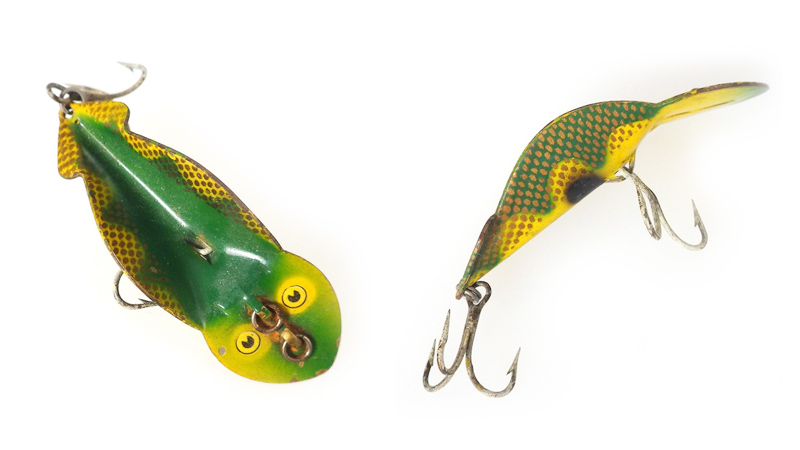
Much has been learned about how the eyes of fish function. That said, the following information is a combination of science and speculation. Within each species of fish there are a certain number of color-sensitive cells (cones), and scientists make assumptions based on their relative sensitivity.
Goldfish and minnows have 4 sets of color vision cells (cones) that have peak sensitivities to orange, yellow-green, blue and ultraviolet (UV) light. The output of these sets seem to be evenly matched, which means that goldfish see blue and UV light as brightly as yellow and orange light. Goldfish, minnows and similar species have adapted to clear water where UV and blue light are commonplace.
Other fish species that have adapted to similar clear-water environments probably have similar color-vision abilities. Trout for example, seem to see UV light very well.
Wisconsin Walleye (Alder Lake)
Walleye and sauger lack blue cones and sense the entire spectrum using only orange and green cones. They’re adapted to murky river water, which absorbs most of the blue and green light, but reflects and scatters primarily red, orange and yellow light. The UV sensitivity of walleye hasn’t been thoroughly checked, but murky water also rapidly absorbs UV light. So… it seems unlikely that walleye see UV light…
About 90% of the walleye’s cones sense the red-orange-yellow portion of the spectrum. The other set senses yellow-green, blue and violet. As a result, scientists presume that walleyes see red-orange, orange, and yellow-orange as bright colors. Green is an intermediate color, but blue and violet are weak and likely appear dark and nearly black.
“Look at the teeth!”
Black bass and sunfish have cones that seem similar to those of walleye, however, they lack the reflective eyes and super-sensitive night vision cells (rods). Tests on the vision of bass have indicated they discriminate poorly between yellows and grays, and there seems to be some preference for reddish colors.
This suggests that bass – like walleyes – have only two sets of cones.
Bass however may not depend as heavily on the red end of the spectrum as walleye, and their UV abilities haven’t been described.
So, as we said in our previous post – What Colors Can Largemouth Bass See? – experiment. Test things for yourself, on your body of water. Over time more science will become available, but what really matters is what the fish will bite.
The only way to figure that out is to get a presentation in front of ’em.
Tight lines!
Subscribe
Join us as we continue to work on becoming better anglers – and better men.
Your support directly funds the creation of weekly articles and videos that promote the development of better anglers and better men. Our country (and our kids) need both. Please share this site, and consider a monthly, weekly, or one-time donation. You are helping us make a difference!
Things underwater are… different… than they are above. Movement is met with more resistance. Things sound different. Vibrations travel through water. Light is broken up by the surface, especially in windy days.
Colors underwater are no exception.
They are different.
That shirt is definitely visible underwater and attracts bass. No question. ‘Murica!
For example, the absorption and scattering of light underwater reduces and eliminates shadows. Shadows usually disappear at about twice the depth the angler can see a large fluorescent or white lure. This “scattering” of light is also used in photography. Items called “diffusers” come in a myriad of sized and they break up light so that objects on a table or within a white box don’t have such a direct, distinct shadow.
To date, research on the color vision of bass has produced some contradictory data:
Bass do see colors, discriminate between them, and learn to avoid colors with negative consequences.
Different reports have returned different results. In some cases, bass see black best, followed by yellow, white, green and blue. In other cases, bass saw red best, but were actually attracted to yellow.
Underwater observations show that bass can discriminate between different colors of monofilament line.
This same study suggested that bass were repelled by bright yellow monofilament, but attracted to fluorescent green-blue line.
In another study, bass in a tank test chose minnows dyed red over natural minnows.
Yet another study found red and white lures to be particularly effective.
This is interesting, because many anglers will use red line because it is a color that disappears quickly underwater. This would contradict the idea that red hooks indicate “blood in the water”… perhaps they just aren’t as visible??
You’ll have to experiment for yourself. Personally, I don’t shy away from red hooks, red swivels, or red beads – but I have not experimented with red line. I just stick with fluorocarbon or really light clear or clear/blue mono.
Note: it is my belief that color plays an extremely important role in some (not all) bodies of water – especially those that are small or that have a very particular type of forage that the bass are keyed in on. However, bass are far less particular than say, trout, and they are experimental eaters. This means that you always have a chance of catching bass when using the “wrong” color. But if you can zero in on the magic combination – it’s lights out!
(Color is a variable to pay attention to after you have found the fish, after you have figured out their depth, and after you have found a few presentation profiles that they will strike. It’s not unimportant, but it’s not at the top of the list when it comes to a great day on the water. Be careful you don’t give it too much attention.)
Keep experimenting and see what you find out.
Tight lines!
Subscribe
Join us as we continue to work on becoming better anglers – and better men.
Your support directly funds the creation of weekly articles and videos that promote the development of better anglers and better men. Our country (and our kids) need both. Please share this site, and consider a monthly, weekly, or one-time donation. You are helping us make a difference!
In the last article, we discussed the sense of sight for largemouth bass – arguably their most important sense for both hunting and ambushing prey, and avoiding danger.
Bass can see on both sides of their body, thanks to the positioning of their eyes. Blind zones exist to the rear, and underneath their bellies. Bass also have binocular vision in front of them, in a forward and slightly upwards direction. Prey (or lures) that enter this “binocular aiming area” are most effectively targeted and attacked.
Prey or lures in the other detection zones may also be accurately attacked if the bass has time to turn and focus in the binocular zone. Objects in the “dead zones” may go undetected – or be ignored.
Bass learn early on to fear attacks from the rear. This is why they will often back into cover. To protect themselves.
We also know that active bass can both see and target lures before they hit the water. This means they can obviously see objects outside of their domain… and that includes us, it includes boats, it includes any and all movement.
In calm water, bass have an especially good view of surface objects. If the water becomes choppy (think windy days) it blurs and reduces what can be seen above the water. This is just one of the reasons anglers will say “the wind is my friend” – it’s an added layer of camouflage, and it makes lures like spinnerbaits even more productive.
The following illustration shows what a bass can see in an upwards direction when the water is perfectly calm:
Water surface and aerial window as seen from beneath.
They can see us.
Quite well actually.
Whether you are walking the shoreline or fishing from a boat, it is in your best interest to wear neutral colors, keep a low profile, and tread lightly. If you’re spotted the bass could get lockjaw or worse – slowly leave the area entirely.
Talk about torture… I’ve watched many quality fish slowly saunter off after they have spotted me or felt the vibrations from my footsteps.
Camo ain’t just for deer hunters…
Tight lines!
Subscribe
Join us as we continue to work on becoming better anglers – and better men.
Your support directly funds the creation of weekly articles and videos that promote the development of better anglers and better men. Our country (and our kids) need both. Please share this site, and consider a monthly, weekly, or one-time donation. You are helping us make a difference!
Bass – like us – have the typical 5 senses: sight, hearing, touch, taste and smell. But there is a sixth as well: lateral line sensitivity. This sense allows them to perceive low-frequency vibrations through sensors located on either side of their bodies.
These six senses help the largemouth bass decipher the information and environment that surrounds them. However, the amount with which a particular bass will lean on one of these senses over the others will vary based on the special attributes of their particular environment. For example, bass living in clear water may be much more sight-oriented, while bass in murky water favor lateral line perception and hearing.
With that in mind, let’s take a closer look at the senses of the largemouth bass.
Largemouth Bass at Sunset in Wisconsin… ‘Murica!
The Sense of Sight for Largemouth Bass:
In most cases, sight is the single most important sense for the largemouth bass. Some sources over-emphasize lateral line perception and undersell vision – but the truth is that bass simply do not feed at peak performance if their vision is impaired. They can certainly live in all sorts of areas, dingy, dark water included – but to be at their optimum, they need to be able to see.
The eyes of the bass are set on the side of their head. This placement allows them to see both food and danger everywhere around them, except behind them, and directly below their bodies. Bass have 3-dimensional vision only in a small area in front of their noses – yet this is where said 3-dimensional vision needs to be – because this is where they focus on food.
Even clear water carries plankton, silt and other particles that limit their vision to short ranges. Water itself also impedes motion, so fish are most concerned with water and threats at close ranges. While bass can adjust focus to see objects as far as 30 to 40 feet away, at rest they focus on objects about a foot away.
(With that in mind, take a second to think about how and why a bass often relate tight to cover, and why it might provide some sort of a sense of security.)
Bass can also see above the water.
Let me repeat that:
Bass can also see things that are above the water.
Totally incognito… the bass will never see us coming!
An aggressively feeding bass may actually snatch a lure before it even hits the surface of the water. (Obviously these situations are the thing of legend, so if it happens to you make sure to brag about it!) Bass that live in deeper water have an even broader view of objects above the water. Also, the higher an object is above the water line, the easier it is for a bass to see.
If you are hunting bass in shallow water… you better keep a low profile!
Scuba divers have observed that bass do not make an effort to avoid sunlight. This contradicts the old “sunlight hurts the eyes of bass because they have no eyelids” myth. Largemouth are able to make internal adjustments to their eyes to reduce their sensitivity and reduce light intensity.
Bass will usually seek shade, but they don’t need to avoid bright lights. They lurk in the shade because they are safer from predators there – not to mention, shade conceals them from their own prey as well, making ambush strikes (which are extremely efficient in terms of energy spent versus energy gained) much more effective.
Bass will set up in shallow, shaded inlets off of main lakes, and these are great areas to catch some quality fish with (or without) the kids.
Most fish species have rods and cones in their eyes, and largemouth are no exception. Rods are black & white sensors that excel in dim light. Cones are color receptors. As light levels change, bass will adjust reliance on one or the other. When light is dim, they only see black and white. When light and visibility are adequate, they see color(s).
Bass see better in dim light than humans. Not as well as fish like sauger, though – as these fish have eyes that are expertly adapted to low light conditions. At night, bass will feed – but they use a combination of lateral line sensitivity, hearing, and by silhouetting prey against the night sky.
Overall sight plays an extremely important role in the life of a bass. Don’t overlook the visual aspect of your presentations if you want to catch more fish.
Tight lines!
Subscribe
Join us as we continue to work on becoming better anglers – and better men.
Your support directly funds the creation of weekly articles and videos that promote the development of better anglers and better men. Our country (and our kids) need both. Please share this site, and consider a monthly, weekly, or one-time donation. You are helping us make a difference!
As we mentioned in our previous article on Prey Size for Largemouth Bass, the size of a largemouth bass with have a major influence on the size of their food.
The Lower Limit is determined by whether or not the effort required to catch a small meal will return an adequate amount of energy. Bass will not waste too much energy to catch a small meal, resulting in an overall loss.
The Upper Limit is determined by what they can actually fit in their mouths… without choking. Samples of preyfish have been taken from within their stomachs – some as large as 50% of their overall length – however, much more manageable quarry is usually pursued.
The following chart shows the length of bass compared to the length of preyfish to give us a relatively solid ballpark range, which will help us select lures and presentations that will adequately target the fish we are looking for.
The shaded area shows the size of the preyfish that largemouth bass typically eat. Although bass may eat preyfish as small as about 10% of their own length, or as large as 60 to 70 percent.
MOST preyfish fall between 20 and 50 percent.
Larger bass tend to eat larger prey. Most of the food of young adult bass falls between 20 percent and 40 percent of their own length, while older and larger bass tend to select preyfish in the 30 to 50 percent range, depending on prey shape.
This makes one wonder if the older fish are slightly wiser, able to discern and select food(s) that are a size they can manage to eat without discomfort, while minimizing the energy expended and maximizing the energy gained…
Hmmm… I wonder?
Either way – this gives us some insight into the preferred prey size on the big bass buffet.
Now let’s go get some.
Tight lines!
Subscribe
Join us as we continue to work on becoming better anglers – and better men.
Your support directly funds the creation of weekly articles and videos that promote the development of better anglers and better men. Our country (and our kids) need both. Please share this site, and consider a monthly, weekly, or one-time donation. You are helping us make a difference!
The size of an individual largemouth bass will determine prey size – the upper and lower limits of what they will hunt and ambush – of what it can and will eat. At times, largemouth bass will attempt to eat prey almost as large as themselves. In other situations, bass will have to settle for larger forms of tiny animal plankton when larger prey isn’t available.
Some food is really big.
Some food is really small.
In fact, the second largest bass that I ever caught here in Illinois came on a tiny little Strike King Mr. Crappie Lightning Shad. I was looking for panfish and this behemoth came out of shallow cover and absolutely smoked this tiny little jig.
Click the banner to jump to The Minimalist Fisherman on YouTube.
I love fishing – you never know what you’re going to catch.
The Lower Limit of Largemouth Prey
The lower limit of largemouth prey is set by several factors. First, the prey needs to be large enough to be seen, and also large enough that it’s worth chasing. Bass are not stupid, and they will rarely waste more energy chasing a meal than what they will get in return if they catch it.
Prey must also be large enough to stay in their mouth. To get caught in the gill rakers. These are the thin, forklike spins that block the areas between the gills. Water flows out, while food items remain in the mouth of the bass. Prey smaller than the spaces between the gill rakers can (and will) escape.
The space between the rakers gets larger as bass grow. So larger bass require larger food – for more than one reason.
AJ Hauser with a Beautiful 5 Pound Largemouth Bass
The Upper Limit of Largemouth Prey
The upper limit is determined by the gape of the mouth and throat, and the ability of the bass to catch and hold strong and struggling prey. Crayfish may at times be too tough and painful to eat, even though they can easily fit into the mouth of a bass. Large gizzard shad can be strong and swift enough to escape unless they are taken head-first. Catfish and bullhead are spiny and will fight hard to escape.
My Pet Crayfish Gus – Don’t Eat Him
That means these difficult preyfish may be low percentage targets.
Maximum length of the prey also varies with shape (body type) and other features, like spiny fins. Bass will take longer thin preyfish in longer sizes than thicker sunfish. Studies show that bass will occasionally eat fish that are as much as 60% their own body length.
Largemouth Bass Eating a Largemouth Bass… Unsuccessfully…
Stomach samples show however, that bass usually opt for food anywhere from 10% to 50% of their own length. Twenty percent to forty five percent being the most common range.
Preyfish this size are the best balance between energy required to capture, and the energy gained from eating.
Every prey species has special abilities and tactics that they can use to avoid being eaten. The dash speed of fish increases with size. Bass need a proportional size advantage to run down prey. However, if the target looks sick or injured, bass will pounce and not hesitate attacking larger-than-average prey.
Keep this in mind when you are selecting your next presentation, and try to match the size of your bait with both the local forage, and the size of the bass you are targeting.
Tight lines!
Subscribe
Join us as we continue to work on becoming better anglers – and better men.
Your support directly funds the creation of weekly articles and videos that promote the development of better anglers and better men. Our country (and our kids) need both. Please share this site, and consider a monthly, weekly, or one-time donation. You are helping us make a difference!
We’ve talked about this many times before – but how do you figure out what everyone else is doing so that you can do the opposite? Here are a few quick tips:
1. Ask Around
I know… these days it seems so “old fashioned” to interact with actual people. Especially – *gasp* – ones we don’t already know! The Horror!
One of my favorite things to do it speak with people on the bank, at the boat launch, in the parking lot, the bait shop or the fishing aisle of the local BigBox.
Here’s the secret phrase that will open up a world of information… you ready?
“Catching anything?”
Try it.
Test it.
Trust me.
Just say these two words to the next 5 people you pass on the bank with a smile on your face and I guarantee you one of these people will share something you didn’t already know.
Just make it clear that you’re not trying to figure out SPOTS. Don’t waste time looking for SPOTS – try to figure out presentations and techniques.
Never, ever ask a fisherman for his favorite spot. He will not share it with you, and if he does – he’s lying.
Ask what he believes to be the best bait. Ask him for his expertise in lure selection. Play to his ego. Don’t blow smoke up his rear, but let him know you are ready to listen and learn – be humble, and there is a darn good chance he’ll share some general information with you that will help you put the puzzle together.
Want to double-check the information you’re getting? Try this.
Head to the local BigBox store and take a look at what is on the shelves.
The products ON the shelves is are as important as the ones that AREN’T.
Look at what should be stocked that isn’t there – if there are multiple spots for Senkos that are sold out – chances are these are being used heavily in the local area. You can either try some of your own as a starting point, or opt for something a little bit different – for example, a heavy salt Zoom Zlinky.
If you have a Bass Pro nearby, you can look there as well… but you will get better information at Walmart, Farm & Fleet or Rural King.
Why?
Because these stores are ONLY going to stock what sells fast locally – products that they know they can move quickly. They are dealing with a healthy mix of hardcore anglers that are looking at the fishing section while getting groceries with the wife, but also hobbyists and dreamers that have a limited knowledge base (no offense of course) and limited time.
Bass Pro needs to keep all of their shelves stocked so they are seen as the authority. They are equipped to meet your every fishing need (and want). Therefore, stocked shelves are just as important to them in terms of how they are perceived by their customers, and their bottom line.
Fortunately this is a win-win, because they also know that they can move less trendy items.
Moving Forward
So go ahead – take a peek. Ask around to get a grasp on what people might be using, but then double check what they tell you by stopping by the fishing section at some of the smaller chain-type stores.
You might be surprised at what is – and what isn’t – on the shelves.
Oh… and remember – never trust that a serious fisherman gave you his “best spot”.
That would just be silly.
Tight lines!
Subscribe
Join us as we continue to work on becoming better anglers – and better men.
Your support directly funds the creation of weekly articles and videos that promote the development of better anglers and better men. Our country (and our kids) need both. Please share this site, and consider a monthly, weekly, or one-time donation. You are helping us make a difference!
Largemouth bass – and many other species of fish – exhibit an interesting coloring on the upper and lower portions of their bodies, called countershading.
This is extremely important for a number of reasons.
Largemouth bass also blend in with their habitat. In most instances they exhibit countershading – their backs are dark, and their bellies light. This helps them blend in with the darker bottom when you look down in the water, but their light bellies blend in better with the surface when you look up at them from below. The body colors are accentuated even further depending on the environment in which the bass is living. The combination of chameleon-like coloring plus countershading offers both protection from predators, and camouflage aiding in their ability to remain undetected by their prey. This is very important as bass are opportunistic predators that will wait to ambush any food that passes by.
My brother with a nice largemouth with very distinct countershading, caught on an inline spinner in a backwater area next to Alder Lake, Wisconsin.
Here is another example of a bass taken out of shallow water with a lot of algae and mucky cover, but relatively clear water and decent visibility:
Illinois largemouth bass
This bass was taken from shallow murky water with poor visibility with no mucky cover. Notice the lighter coloring which helps the bass blend in with it’s surroundings – not stand out. (This is why anglers will use dark plastics and lures in murky water, the dark coloring silhouettes and stands out better – that’s the opposite of what these bass want to do, whether for protection or camouflage while hunting prey.)
Illinois largemouth bass in the jon boat
If fish weren’t countershaded but simply a single, solid color, they would appear like this in the water under normal light conditions:
This is the opposite of what we are used to seeing when observing bass from above the water.
When light is projected from all sides, fish appear like this (below) with countershading. This is the way that we normally see fish, because light is reflected off of the bottom. Fish become less visible when viewed from above or below.
In reduced light conditions, countershading can completely conceal a fish while they are holding still. Countershading is therefore even more effective in low light conditions, in the morning or evening, at twilight or after dark, even in dingy, deep water.
The next time you’re out, look around and see if you can spot any bass standing out against the bottom of your lake. Now that you know how and why bass exhibit this coloring pattern – maybe look a little harder.
Tight lines!
Subscribe
Join us as we continue to work on becoming better anglers – and better men.
Your support directly funds the creation of weekly articles and videos that promote the development of better anglers and better men. Our country (and our kids) need both. Please share this site, and consider a monthly, weekly, or one-time donation. You are helping us make a difference!
When largemouth hatch, they are nourished by a yolk sac for several days while their tiny little mouths continue to develop.
Egg Sac Largemouth, Bluegill and Redside Shiner
Then, after this brief period, largemouth bass “fry” depend on zooplankton and tiny crustaceans.
When they get slightly larger, they switch to insects and small fish, including each other.
While bass eat many things, they are generally piscivorous (fish eaters).
Early Morning Pit Bass in Illinois
They will often select soft-rayed minnows if they are available, but they will also eat sunfish, spiny channel catfish and bullheads – or again, smaller bass.
To imitate minnows, look to something like the Strike King Tour Grade Swim Jig, and try a subtle trailer like a Zoom Fat Albert Grub. This combo mimics the small frantic tail vibrations of a fleeing baitfish:
Shad are a major food source for bass in many reservoirs, although shad are an atypical food as bass don’t usually chase food in open water where shad often school. That said, shad are so abundant and nutritious that bass have adapted to feeding on them.
To mimic a shad around cover, try a spinnerbait. If the water is murky, check out something like the Booyah Colorado Blade Spinnerbait:
Crayfish are also an important food source for largemouth bass. We discussed earlier that largemouth bass are better suited for feeding up – but they will definitely strike at food(s) on the bottom. The pincer-like jaws of a smallmouth bass are better suited for snatching meals off the bottom and out of rocky crevices , though. If crayfish are abundant, bass will feed on them primarily. Crayfish migrate to the shallows in the spring, then move steadily deeper throughout the warm months – but rarely below the thermocline.
Frogs are usually associated with largemouth bass, but they aren’t really a major food item until the fall, when frogs make their annual run from the shallow marshy areas and meadows to deeper water where they will hibernate. Bass can sense the increased activity, and they move to intercept.
Salamanders and large insects are also important food sources in some water.
Overall, when it comes to selecting a bait, start off the water. Do some research on the area you’re fishing to find out what food is available, then match the hatch and work on improving your offerings from there. It won’t always be the best option, but it will give you a good place to start.
If we understand what bass EAT, we can better select our BAITS, which means we have the best possible chance of catching more FISH!
Get out there and get after it.
Tight lines!
Subscribe
Join us as we continue to work on becoming better anglers – and better men.
Your support directly funds the creation of weekly articles and videos that promote the development of better anglers and better men. Our country (and our kids) need both. Please share this site, and consider a monthly, weekly, or one-time donation. You are helping us make a difference!
Most of the bigger bass that you come across are females.
AJ Hauser with a pot-bellied largemouth bass on a warm summer evening, caught on a weightless tube.
Females typically live longer than males.
But why would… why would females live longer than males?
No idea.
In certain areas of the country, females also grow faster, and when it comes to body structure, males are more streamlined or lean. Compact. Females are broader with larger, heavier bellies. These differences are most easily seen during spawning time.
Bass probably don’t grow in water colder than 50°F, and they grow slowly in water between 50°F and 60°F. This means that northern bass have a shorter “growing season” than southern bass.
In fact, some bass in the south grow every month of the year.
Every. Single. Month.
While this has an impact on their size, it also has an impact on life expectancy. Largemouth bass in northern states may live longer than 15 years, however, a 10 year old bass in the south is considered old.
Mexico and Cuba are famous for big bass – but because of the life expectancy for bass in this environments, it seems unlikely that a world record size bass will be caught in these areas. Conditions aren’t quite right… in theory.
When it comes to identifying male and female bass in the field, look at the body structure first. If it’s near the spawn you can squeeze the lower belly to see if any eggs or milt are present.
Yes, milt is the opposite of eggs and exactly what you think it is.
I guess you could also sneak up and peek at them in the bathroom to see how they pee.
o_0
Tight lines!
Subscribe
Join us as we continue to work on becoming better anglers – and better men.
Your support directly funds the creation of weekly articles and videos that promote the development of better anglers and better men. Our country (and our kids) need both. Please share this site, and consider a monthly, weekly, or one-time donation. You are helping us make a difference!
There are easily more than 20,000 species of fish found worldwide.
Among these species, a multitude of body shapes exist. Different designs are adapted to the wide range of habitats and behavioral diversity these fish exhibit.
Catching some nice trout trolling the great lakes.
Fish face resistance to forward motion. Water is much more dense than air, and a streamlined shape minimizes this resistance. Certain fish like pike and muskie can make amazingly fast directional bursts, and some open water fish resemble cigars.
My wife with a nice Canadian pike – literally a swimming missile.
However, this tubular body shape is a compromise, because while these fish excel in straightforward bursts of speed, they lack the maneuverability of broad-bodied fish – especially in tight quarters. The forward propulsion of a streamlined fish is produced via lateral body thrusts supplemented by caudal, dorsal and anal fins. “Flatter” body types provide good propulsion, but also aid in maneuvering in cover.
AJ with an early morning Illinois muskie – shot out of the depths like a rocket to attack a black bucktail with bright green blades.
Again, pike and muskie approach the optimum hydrodynamic shape. They have large dorsal and anal fins (near the rear of their body, as opposed to the mid-body dorsal fin placement of some other fish) which allow for massive bursts of speed, but then fall short in maneuverability.
The flattened bodies of crappie and bluegill don’t allow for fast forward movement, however, these fish can easily make sharp turns and quickly move up and down. Their rounded shape and large fin area also aid in swimming backwards.
Wide bodies make for sharp turns.
Largemouth bass (again, a sunfish) and similarly shaped fish have compromise shapes, which allow them to operate in a wide range of habitats.
They can function well in both open water and cover.
The next time you’re on the water, take a few minutes to observe and appreciate the differences between all of the different fish you catch or see. Make an effort to look at the placement of the fins and think about how that along with the shape of their body could help them survive better – or worse – in different kinds of water, cover and conditions.
It might just help you identify better areas for your target species… which means more fish.
Tight lines!
Subscribe
Join us as we continue to work on becoming better anglers – and better men.
Your support directly funds the creation of weekly articles and videos that promote the development of better anglers and better men. Our country (and our kids) need both. Please share this site, and consider a monthly, weekly, or one-time donation. You are helping us make a difference!
The largemouth bass is a chunky lass. Dummy thicc, if you will. She’s a powerful fish, full of vinegar and whatnot, with a broad body that allows for powerful bursts of speed and tight maneuvering in confined areas.
But shame on me – focusing on the body and passing over the most prominent and definitive feature of this fish:
… her huge mouth.
*A bead of sweat is forming on my head as I struggle to control the urge to make a ridiculous dad joke about big-mouth females… too easy… too easy…*
The largemouth bass doesn’t have sharp teeth like walleye, pike and muskie, but their huge maws easily engulf most prey.
This large mouth is a feeding advantage. When the bass attacks a school of minnows for example, the mouth opens wide and the gills flare – like targeting a dove with a shotgun loaded with bird shot, instead of using a rifle.
One of those two methods is far more efficient.
In addition to the large mouth, she also has a big pot belly. It’s expandable. It stretches. It hangs over her belt. It accommodates a fair amount of… whatever she put in there. This is good, as the largemouth is an opportunistic feeder. When an easy meal approaches, that extra space is put to use.
Look at the pot belly on this piggy. She was clearly already full, but couldn’t resist a weightless brown Zoom tube – similar to the Strike King Coffee Tube – tossed into her pond right as the sun was setting.
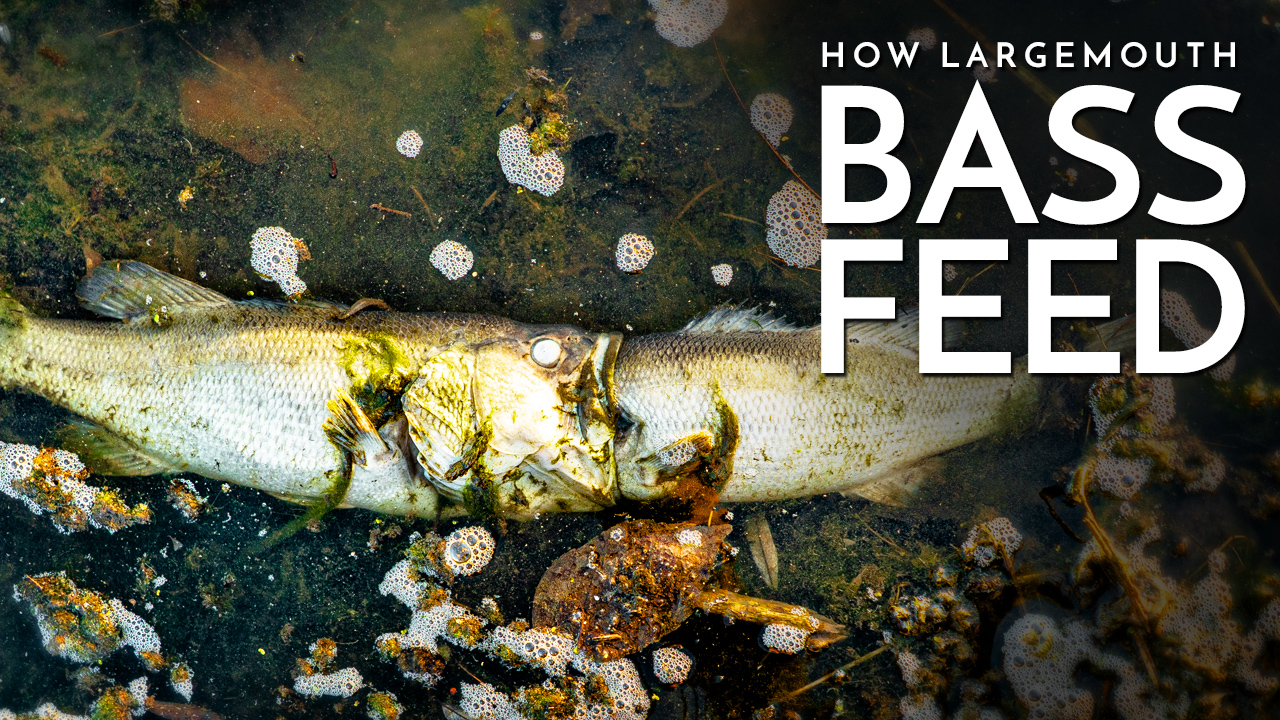
Bass can catch and swallow a variety of prey types and sizes, but they are limited to what they can fit in their mouth. I’ve used this image too many times lately, but this was what we found on a recent trip around the lake during the cold water period… it shows how far that mouth can stretch, even though this one didn’t stretch quite far enough…
Largemouth bass eating a largemouth bass… unsuccessfully…
The lower jaw of the largemouth is long and underslung. While this allows them to eat larger prey, it also makes them less adept at snatching food up off the bottom. Smallmouth bass have tweezer-like jaws and a smaller belly, along with a more slender, streamlined body – making them much more efficient at plucking crayfish from crevices.
Studies have suggested that largemouth as most effective when they feed up – however, they will take prey off of the bottom, at mid-depth and on the surface.
Like other sunfish (remember, the largemouth bass is a sunfish) she has adapted well to living in heavy cover, weeds or wood. These areas better suit her than someone like the pike. While pike have missile-shaped bodies and the ability to cover a lot of water very quickly due to their hydrodynamic shape, that do not have the ability to make hairpin turns in confined areas.
Canada pike patrolling a deep weed edge, caught on a big swim jig with a steady retrieve.
Bass can maneuver very well in these areas, and even effectively track and take lures moving erratically in heavy cover. They can quickly change direction while maintaining speed.
The largemouth bass can swim at about 2 miles per hour for long periods, with a burst speed estimated at 12 miles per hour.
5 times faster than you can retrieve a crankbait.
Bass, like many other fish, have scales. These scales offer protection from attacks by predators and parasites, but they prevent the largemouth from sensing their environment through their skin. The skin is an important sensory organ.
Largemouth bass also blend in with their habitat. In most instances they exhibit countershading – their backs are dark, and their bellies light. This helps them blend in with the darker bottom when you look down in the water, but their light bellies blend in better with the surface when you look up at them from below. The body colors are accentuated even further depending on the environment in which the bass is living:
An Illinois pit bass with golden, light coloring…
Compare that to this bass taken in the exact same state from a different body of water with thick cover:
A largemouth with distinct countershading and dark green coloring taken from a pond with heavy, green cover.
The combination of chameleon-like coloring plus countershading offers both protection from predators, and camouflage aiding in their ability to remain undetected by their prey. This is very important as bass are opportunistic predators that will wait to ambush any food that passes by.
Murky water transmits less light. In murky water, bass coloring fades, making them less conspicuous. In the example above, the pit bass lives in very clear water with high visibility, however the bottom is light colored sand. The bass below is also very light colored, but lived in a lake with very poor visibility. So even though the bottom is made up of dark rocks and debris – the water clarity is low – so the bass have lighter coloring.
As a rule of thumb, bass exposed to sunlight in shallow clear water will have darker backs and bright green sides, but bass in deep or turbid water are pale and silvery.
It is also believed that active bass are darker than inactive bass, as their green coloration camouflages them in weedy habitat – especially wherever plankton and algae are present.
The combination of all of these attributes make the largemouth bass an effective predator. One that can survive and adapt to many environments and many different conditions.
More reasons to love ’em I’d say… as if we needed more reasons…
Tight lines!
Subscribe
Join us as we continue to work on becoming better anglers – and better men.
Your support directly funds the creation of weekly articles and videos that promote the development of better anglers and better men. Our country (and our kids) need both. Please share this site, and consider a monthly, weekly, or one-time donation. You are helping us make a difference!
The largemouth bass is distinctly different than the brook trout. As we discussed earlier, the brook trout was at one time the most popular gamefish in the United States. So targeting bass required the anglers of the day take a very different approach. Let’s look at some of the differences between bass and trout – specifically, how they feed.
If we understand how they eat, we stand a better chance of catching them (once we’ve found them).
Stream trout are adapted to life in current. While this may require more energy (unless nice, calm eddies and resting areas can be found) the benefit is that the current brings the fish food. The constant use of energy requires a steady supply to replenish what is used up – and this must be done efficiency. Trout can’t afford large, wide searches for food or make poor use of the food that flows towards them. Therefore they will often spend hours feeding from a current break, looking for insects primarily. Large insect hatches are a very reliable source of food for the trout, especially those that are small to medium sized.
A Beautiful Specimen: The Brook Trout
Not all floating items are edible however, so trout rely on keen eyesight and the ability to identify “food” from “not food”. Because of this trout feed selectively, often “locking on” to a specific food type and becoming picky – sometimes only eating a single type of insect. They will eat insect after insect, but ignore something like a frog. That frog could provide much more nutrition in a single meal than the giant handful of insects that will take the trout hours to catch…
… if you’ve ever fished for bass, you know where this is going…
Largemouth bass are distinctly different. They have huge mouths and large bellies, and this allows them to take advantage of many types of prey. Largemouth can seize and digest food that will fit in the width of their mouth. This means that the supply of food available to largemouth is much more flexible and broad: snakes, ducks, bats, turtles, frogs, dragonflies, crayfish and mice are all fair game.
Careful… your crayfish claws are showing…
If streamlined baitfish are available, bass will often target them over spiny-finned broad-bodied sunfish (remember, the largemouth bass is actually a sunfish), but chances are they will not eat one exclusively. Bass are opportunistic feeders.
This may not have been the best opportunity…
Overall bass are far less finicky about what they eat – however, they will usually avoid carrion. Bass are much more experimental with their food, while trout on the other hand don’t enjoy the same luxury. This is one of the reasons why bass lures come in such a variety of shapes, colors and actions.
Bass key in on vibrations and patterns of movement that suggest vulnerability to attack.
Reaper tail largemouth bass taken from shore in Wisconsin, in a backwater area.
As bass move from location to location, their feeding habits change based on the available food, but when fishing for these green monsters, baits need only look alive and vulnerable. They must be presented within the strike zone, which will vary from day to day depending on the current conditions – but overall, fishing for bass is more forgiving.
Fishing for trout requires the exact imitation of the food they are eating. Getting this specific for bass only enhances your chances of a remarkable day on the water – but even novice anglers can do well fishing (around fish) with baits that look alive and vulnerable, even if that bait is not an exact imitation of their primary food source.
That doesn’t mean fishing for bass is easy, but it does mean it is different.
In many bodies of water, the dominant forage is small baitfish and crayfish when they are available. These meals are highly nutritious and readily available. Frogs too. As we mentioned earlier, a single frog can hold far more calories and energy for a bass than a handful of insects – insects that would require much more energy to catch.
Experienced bass may exhibit more selectivity, ignoring animals that they know are hard to catch, or dangerous. Some bass have been conditioned to different lures or presentation types. For example, in highly pressured waters where most anglers use rattling baits, experimentation with silent crankbaits can prove to be extremely fruitful. Pay attention to what is going on in the body of water you fish. Talk to other anglers and try to minimize the amount of negative cues you are giving off.
When they zig, you zag.
Bass will always be ready to snap up an easy meal – even if it looks like nothing they have ever eaten before. This is one of the qualities that makes fishing for bass so exciting and enjoyable. You can catch some fish while you continue to fine-tune your presentations to match the hatch.
Now get out there and start experimenting.
Tight lines!
Subscribe
Join us as we continue to work on becoming better anglers – and better men.
Your support directly funds the creation of weekly articles and videos that promote the development of better anglers and better men. Our country (and our kids) need both. Please share this site, and consider a monthly, weekly, or one-time donation. You are helping us make a difference!
Every species of fish has certain characteristics and abilities that help them survive and thrive in different environments. Catfish are known to be “swimming tongues”, tasting their surroundings as much as they feel them with their lateral line. Smallmouth and muskie are both excellent “sight feeders”. Carp reproduce and grow quickly, helping the young avoid being eaten by other preyfish.
The largemouth bass? Well, he has a myriad of special skills – he’s a generalist.
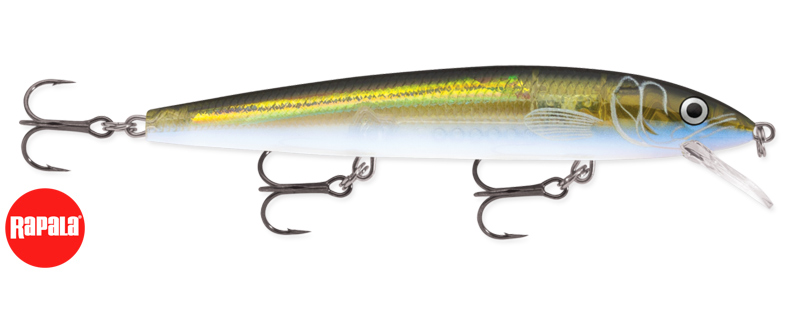
Smallmouth bass caught on a Rapala Husky Jerk – a bait that requires “sight” or visibility to work at it’s optimal level.
A generalist can cope well with change, survive in multiple environments, and adapt to disturbances brought on by natural disasters or man. These same disturbances can be devastating to a specialist, or a fish that requires very specific conditions to exist.
Generalists will adapt.
Generalists will overcome.
Generalists will live in many different places.
Generalists will spread out.
My wife with a great largemouth in a shirt that is way too nice for fishing… caught in a calm Wisconsin river channel (slack water area).
While the generalist species lack a specific approach to feeding, they make up for it with hustle and experimentation. They compensate and eat a variety of prey… and baits… which is good news for us anglers. Nothing is easy for the generalist, but much is possible.
The largemouth bass will find things to eat without being too picky. Like all things in life – it’s a trade off.
For this reason, you will find bass in ponds, lakes, reservoirs and rivers.
Another quality largemouth taken in a Wisconsin river channel between two lakes (slack water).
Over the next several sections, we will discuss certain characteristics that make the largemouth bass unique, and the differences between bass and other species of fish that require much more specific conditions to survive.
They’re all special in their own way…
If you’d like a refresher on Identifying the Black Basses, make sure to hop over to our helpful guide and step through some of the more common – and less common – species. You’ll learn more about what makes them tick, their unique characteristics and their current known range so you can target them yourself if you’re looking for a new challenge or adventure.
Tight lines!
Subscribe
Join us as we continue to work on becoming better anglers – and better men.
Your support directly funds the creation of weekly articles and videos that promote the development of better anglers and better men. Our country (and our kids) need both. Please share this site, and consider a monthly, weekly, or one-time donation. You are helping us make a difference!
Smallmouth bass (Micropterus dolomieu – Micropterus dolomieui is a common, somewhat accepted misspelling) and largemouth bass (Micropterus salmoides) are the two most widespread, popular – and important – of all of the black bass species.
Early Morning “Football” Smallmouth Bass
As their name suggests, the biggest differentiator between the two is the size of their mouth. The jaw of the largemouth extends past the eye (when the jaw is closed), while the jaw of the smallmouth ends before the eye.
Largemouth bass usually have a dark horizontal stripe on their body – which explains the nickname “linesides“. Smallmouth bass typically showcase beautiful vertical bars on their bodies, and angled lines on their face & gills.
The Northern Smallmouth Bass can have light or dark coloring – Micropterus dolomieui dolomieui
The Neosho Smallmouth Bass
The Neosho Smallmouth Bass is a stream loving strain. They can be found in Arkansas and Oklahoma waters – again, usually in streams. If you are targeting a true Neosho, look to 6 different counties in Oklahoma: Ottowa, Delaware, Adair, Cherokee, Mayes and Sequoyah. (Locals also claim that southeast Oklahoma is home to the genetically distinct Ouachita smallmouth bass.)
On rare occasions, Neosho bass will be caught in Grand Lake, the dividing line between “true” and “contaminated” strains of smallmouth bass; a result of the state’s stocking programs. In years past, this subspecies was described primarily using slight differences in counts of the second dorsal fin rays, pigmentation patterns, and dentition on the tongue – however these are not flawless methods as the differences between the Neosho and the northern smallmouth are subtle.
In the field, the fastest way to identify a Neosho is to look at the bottom lip. When the mouth is closed, it will protrude ever so slightly – more than a northern strain – as if the fish is enjoying a pinch of snuff.
The Neosho Smallmouth Bass – Micropterus dolomieui velox
A Freshwater Chameleon
You may have noticed something while looking at the pictures above. One example of northern smallmouth was light, the other, dark. That’s because both largemouth and smallmouth bass will change color to blend in based on their surroundings. Largemouth can be deep, dark green in heavy cover, or light green, even somewhat golden – when taken from sandy bottom pits, as shown below:
Notice the golden color and light contrast on this pit bass that lives on a sandy bottom…… compared to the deep coloring on this bass caught in the same state out of a pond with dark, thick green cover.
Smallmouth bass are often a nice golden bronze or a dark brown. In our experience, smallmouth caught off weed edges seem to have more contrast and showcase their vertical bars. Sandy bottom smallmouth living by sunken logs and boulders usually exhibit less contrast, and a more uniform color overall.
Dad releasing a nice smallmouth bass with excellent contrast and coloring, caught on the deep weed edge.
Largemouth and smallmouth bass are both omnivorous, opportunistic feeders, but smallmouth are better adapted at feeding on crayfish and smaller crustaceans in rock crevices. The mouth of a smallmouth is more pointed and better for feeding down than that of a largemouth. Smallmouth also have a more streamlined body better suited for rivers and current.
Like the largemouth, the smallmouth bass has been widely transplanted outside their original, native range. From Northern Minnesota and the Canadian Shield Lakes, to New England and the mid-Atlantic states. Introductions have also taken place in rivers and reservoirs throughout the western United States.
Indeed, many bodies of water that once held no smallmouth now offer world-class smallmouth fishing.
Known Range of Smallmouth Bass in The United States – Visit USGS.gov for current information
In certain locations, largemouth and smallmouth can be found in the exact same areas, even though these fish have evolved in different habitats. Smallmouth typically thrive in cool, clear lakes and rivers with gravel bottoms and moderate flow.
We discussed this in our series on Learning to Fish Rivers & Streams. The headwaters of a stream or river are clear and cool, the flow is faster. This is ideal trout water. The middle section slows and becomes warmer as the water runs through shallow riffles and watersheds. This section will hold more walleye and smallmouth. Still further down, the stream widens out, more tributaries enter, and the pool-run-riffle pattern repeats again and again, warming the water even more and ultimately providing excellent largemouth bass cover in the backwaters and oxbows that form.
The different fish are perfectly matched to these different conditions.
Smallmouth and spotted bass (another subspecies we’ll talk about in the next section) thrive in highland reservoirs, while largemouth bass do best in flatland or lowland reservoirs. Some reservoirs are diverse enough to provide habitat for all three of these bass types:
Spotted bass may prefer the deep midsection of a reservoir, largemouth will opt for the shallow arms in the upper third, and smallmouth may set up in the lower third.
No matter where they are located, smallmouth bass have distinct features and advantages in certain environments – and they fight hard, making them extremely fun to catch – no matter what size!
Tight lines!
Subscribe
Join us as we continue to work on becoming better anglers – and better men.
Your support directly funds the creation of weekly articles and videos that promote the development of better anglers and better men. Our country (and our kids) need both. Please share this site, and consider a monthly, weekly, or one-time donation. You are helping us make a difference!
*zzzzziiiiiinnnnggggg* screams the drag as line is violently ripped from your spinning reel.
“Whaddya got on there buddy, a big ‘ol bronzeback?!“
“A what!?“, you holler back to Grandpa as he drops his Zebco and scampers over sticks and brush, moving quickly towards your current location.
“A bronzeback! Big ‘ol hawg. Lookin’ like a dang football!“
You look around scanning the shoreline, expecting to find a handful of empty beer cans. “You said you had coffee in that thermos not hooch! Why the heck are you speaking in tongues?!“
“A smallmouth bass kid! But I guess probably not in a pond… Oh waitwaitwaitWAIT I see some green – you got a spot? Meanmouth? Kentucky? Or did you hook into a nice bucketmouth?! Black bass?! They’re all black bass… WAIT – I see ‘er – ‘ol linesides!!! Looka’ thar looka’ thar whatta TOAD!!“
*ker-SPLOOSH!!*
“Grandpa… are you off your meds?“
“JUST LOOK AT THAT DONKEY!!!“
The monster bass makes another acrobatic leap out of the water, then returns to the algae-covered pond with a massive sideways splash that further disrupts everyone still inside their tents at the campground. The once silent morning has been completely shattered by what sounds like a crazy person. The two of you make eye contact for a brief second, and the look on Grandpa’s face lets you know he is not joking.
*zzzzziiiiiinnnnggggg*
The green behemoth pulls you back to reality, making another extremely powerful run.
“We gotta land that fatty! He’s a giant! A gorilla! A REAL WHOPPER! What a BRUISER! STUD MUFFIN! A BEEFY CHUNK BOX!!“
“Grandpa seriously…“
“SHAMOOOOOOO!!!!!“, he screams as he angles his head back and releases a primal howl. It’s as if this fish has awoken something deep inside – something that has been dormant all winter, begging to be released.
You bend down to the edge of the mucky water, slowly pulling the bass towards your outstretched hand.
“Just a bit closer darlin’… a bit closer… lemme get a lip on ya…“, you mumble to yourself… pulling a bit too hard on the line…
*pop*
The hook flies out of the mouth of the fish just two feet from the shoreline.
Your heart stops.
You look down down in disbelief at your hand – the hand you were unable to place within the maw of the fish.
“No… no… no no no… nononono…”
“SHAMOOOOOOO!!!!!” Grandpa screams again as he lunges past you, flinging himself head first into the water, tearing the thick green mat covering the pond in two. He seems crazed. Unwilling to accept defeat. This is not the one that got away!
You take a step back, wiping the splatter from your own face and notice he’s managed to place a hand on the beast. Then another. He lifts the fish then drops it. It flops left. He goes left. It flops right. He goes right. Reflexes are on high alert. Adrenaline coursing through his veins. It’s like watching someone wrestle a greased pig; the fish is bucking like a crazed bronco – but this ain’t Grandpa’s first rodeo…
“GAHHHHHHHGetOverHereYaBigFatCowIGOTCHAAAA!!!“
He thrusts his arm towards the sky… along with a beautiful 6 pound largemouth bass. Not a blemish on her. Truly a giant for this campground pond. His knuckles are white aside from the blood, and his grasp on the lower mandible resembles something closer to a vise-grip than a human hand.
The sun, now peeking over the trees provides a soft warm glow behind the mighty warrior. One might describe the scene as angelic… if the victor wasn’t completely covered in foul green sludge.
“Here’s your mondo,” he says with a pleasant Grandfatherly smile, extending his arms and the fish towards you.
“No Grandpa, you earned it. It’s your fish.“
“OUR fish then“, he smiles again, covered in stinky green pond scum, “let’s see if anyone is awake and ask them to snap a picture.“
He looks right at you as the blood immediately drains from your face…
“I forgot the camera.“
Silence.
A cardinal sounds off.
“Ha! That’s ok… I don’t think we’ll forget this one…“
The two of you take one more gander at the magnificent specimen and gingerly place her back in the shallow water, holding her by the belly and gently working water through her gills. Then after just a few seconds, you watch as she slowly saunters off. No doubt she’ll live to fight another day.
The calm morning sounds have returned to the campground, and as the two of you watch the ripples slowly fade, you share the exact same thought:
What a perfect morning.
All About The Black Bass
Largemouth bass are often called black bass, which can be confusing – mainly because they aren’t “bass” at all. What about all those other fish we call bass, you ask? Well, they’re not really related to largemouth… because the largemouth is a sunfish.
I know, I know… mind blown.
The largemouth bass is the world’s largest sunfish.
Known Range of Largemouth Bass in The United States – Visit USGS.gov for current information
The sunfish family, Centrachidae, includes 33 species that live in warm or cool water. Their flat bodies offer plenty of fin area, useful for short bursts of speed and maneuvering in tight places. Sunfish have spiny dorsal fins – in fact, the name “bass” is derived from the Old English word baers, meaning “bristly like a wild boar“. These spines give sunfish limited immunity to attack, as preyfish will often opt for soft-rayed morsels over spiny sunfish.
If they don’t… this can happen:
Such a waste. During our last walk around the lake during the cold water period we came across this bass whose eyes were definitely bigger than his stomach…
Sunfish are shallow-water nest builders. The male is tasked with protecting the eggs and the young (with the single exception of the Sacramento perch… which is a sunfush, not a perch… to help add to the confusion).
However, the largemouth differs from their sunfish cousins in many ways. If you’ve ever caught a sunfish you may have noticed their small mouths are perfect for feeding on insects, zooplankton and small crustaceans. By contrast, the largemouth has a gigantic maw and a much heavier frame. In certain bodies of water, they are the dominant predator. This means they can use the water and cover in any way they see fit – they can be at any depth at any time.
You’re a… you’re a SUNFISH?!
These characteristics must be advantageous for predator fish, as other fish unrelated to bass have evolved into similar shapes over time. White, yellow, peacock, striped and sea basses are not related to largemouth bass. However, they are called bass because of their body forms. The word bass has been applied to many fish with spiny dorsal fins, big mouths and chunky body types.
#triggered
“Maybe we should stop being so offensive?! Maybe stop fat-shaming and ask the bass how it identifies?? Maybe it’s non-binary?? BIGENDER?!?! GENDERFLUID?!?! HMMMmmmmm????????“
</end sarcasm>
Yeah… maybe.
Maybe not.
I’m most interested in what she wants to eat.
Come ‘ere you fat pig… (he said with love)…
The Black Basses
Within this family of sunfish, the largest members are indeed called the black bass. Again, even this name is confusing – since they aren’t even black! Darker yes, but not black. These black basses include: largemouth, smallmouth, spotted, redeye, shoal, Suwanee, and Guadalupe.
Depending on who you talk to, you’ll come across different “lumps” or “splits” in these species & sub-species, as bass have been continuously recategorized, but no matter what you call them (donkey, toad, football, spot, hawg…) or where you find them – one thing is for sure…
Bass are fun to catch!
So let’s take a look at some of the differences between the most common species that you are likey to find on the other end of your line – all the fish that we lump together into the confusing category of BLACK BASS.
Tight lines!
Subscribe
Join us as we continue to work on becoming better anglers – and better men.
Your support directly funds the creation of weekly articles and videos that promote the development of better anglers and better men. Our country (and our kids) need both. Please share this site, and consider a monthly, weekly, or one-time donation. You are helping us make a difference!
In fishing, the concept of catch & release has been widely practiced ever since the early 1900s… in Europe. In North America however, the trend towards voluntarily releasing gamefish started with a trout & salmon angler named Lee Wulff around the 1930s.
During this time, trout fishing was a top priority, and many anglers had started to realize that the increase in fishing pressure and harvest led to stocking. Lots of stocking. Loads of hatchery trout were dumped into streams, and fishermen found them to be inferior to the native brook trout.
Jason Lucas, a bass fishing pioneer was also known to grumble about “those paltry, hatchery-reared trout“, which helped shift the national focus away from trout to largemouth over his 20-year career with Sports Afield Magazine.
Wulff’s answer to the stocking issue was the separation of catching fish from killing fish.
A good gamefish is too valuable to be caught only once.
Lee Wulff
This idea ran against prevailing management customs and theories in other fisheries, but over time, started to take hold in trout-fishing circles.
In 1971, Ray Scott (the founder of B.A.S.S. – the Bass Anglers Sportsman Society) attended a trout fishing conference in Colorado. He noticed the enthusiasm that the anglers had for releasing trout. Well if releasing a 10-inch trout was a thrill… imagine releasing a 6-pound bass to be caught again and again!
The added benefit for Scott was that catch & release provided a (partial) answer to the disdain tournaments had started to garner from local anglers. Locals didn’t want “a bunch of hotshot anglers coming in and killing all of their fish!” So why not take steps to give anglers “their” fish back, and diffuse the hostile feelings towards tournament fishing at the same time?
Scott began rewarding contestants for keeping fish healthy.
In 1972, bass boat livewells had no aerators. Many were poorly designed. All of the sudden – that changed. (If you needed a testament to the influence of tournament fishing on the sport of angling, make a mental note of this situation.) The scheduling of B.A.S.S. tournaments also changed, opting for cooler water periods to minimize fish stress and fatalities.
So to be fair… the initial interest in catch & release had more to do with reputation, or political maneuvering, than with the actual preservation of the fish. However, in time this practice was shown to help sustain good fishing, and anglers could see the potential damage that could be done through heavy fishing pressure. Many fishermen were shocked when Georgia’s new West Point reservoir showed a serious largemouth bass depletion after only 2 years (the reservoir opened to fishing in 1976).
Thus, thoughtful anglers that were able to look to the future – either selfishly (I want to catch more fish) or otherwise (I want my grandkids to catch more fish) – began to see voluntary catch & release as an important component of long-term, quality fishing. Certain fishery managers began to push for stricter regulations, and over time the black & white mantra of catch & release transformed into the In-Fisherman concept of Selective Harvest.
Selective Harvest
Fish are delicious. They are nutritious. The good Lord put ’em here for us to enjoy – from the lake to the table. However, in order to maintain good fishing and a healthy gamefish population, we need to do our part by stepping away from certain traditions of the past – especially as tackle options and boat electronics become more and more effective.
Stringer shots of giant bass might look great – but removing 6, 8 or 12 large bass that will most definitely spawn in the spring can have a detrimental effect on your lake. When you consider that a fraction of 1% of every group of fry might survive, all of the sudden these trophy fish become even more valuable – but within the lake.
If you want to eat fish – and let’s be honest, who doesn’t – a family fish fry sounds absolutely outstanding right now – focus on species that reproduce quickly and that exist in your body of water in large numbers. Panfish like crappie, bluegill, perch or even bullhead – but remember to release the larger panfish as well.
There are trophies within every species, and monsters need to spread their genes to future generations!
Use your best judgement to define what an “eater size” fish is for your lake, and remember – you can make one heck of a feast with just a handful of fish. Don’t load the freezer every time you’re on the water.
“I’ll never catch any fish around here“, the forklift driver grumbles as he enters hour 11 of his 12-hour shift. “When we go up to the clear northern lakes, man… that’s where it’s at.”
The clang of the tines echo through the warehouse as they hit the floor just a bit too hard. Too hard for an experienced driver like this – unless of course he’s having a tantrum.
“I wish there were pike around me. Or smallmouth. Or walleye. All these ponds and lakes in Illinois is just so mucky – so sloppy – so hard to fish. Can’t use the jig-n-leech I grew up on, it snags everything floating and on the bottom – same with my jerkbait, even my swimbaits with exposed hooks – especially in early spring. Nothing of any quality lives here – the good fish are all far away and there is no way with work I can travel. I barely get enough time to go throw a footballhead jig in the slop for a frustrating hour once or twice a week… I hate this.“
The low battery beep starts to go off on the fork, meaning he’ll have to go swap for a different one and plug his in. A mild inconvenience, but combined with the current foul, frustrated mood – a recipe for total defeat & exhaustion.
“Whatever… I just need to get done so I can go home and go to bed. There is no point fishing when I spend more time picking debris off of my hooks than I do catching fish. Forget it.“
With that, he backs his lift into a “charging station”, designated by some spray paint on the floor, plugs the large plastic power connector into his battery an wanders off – completely defeated – to finish his shift…
The questions our hero should be asking himself are simple, but not always easy to figure out: What fish live around me? Where do they live? What do they eat?
I know this – because I was the forklift driver not that long ago… and until I re-learned how to fish based on local fish, forage and cover, I was constantly frustrated by the fact that the presentations I learned to love as a kid – the ones that worked in clear, natural lakes with distinct weed edges – definitely did not work around me.
At least, not the way I was fishing them. We don’t have pike. Or smallmouth. Or walleye.
Largemouth bass are easy to like – especially after you catch a few. They’re “sporty”, they fight hard, they jump, and even though they don’t fight as long as smallmouth – their broad bodies and tails allow them to pull like an ox.
They’re green little beasts.
Largemouth are known to be scrappy. They are also aggressive, and can be caught on a myriad of artificial baits – hard & soft – fast & slow – depending on the conditions and their location.
There is nothing like hooking into a largemouth bass in shallow water if you are looking for what feels like hand-to-hand combat. Bass can set up in what seems like mere inches of water, and if you hook into a spooky bass in skinny water, they will put you and your gear to the test!
Click the banner to jump to The Minimalist Fisherman on YouTube.
Bass also spend time in areas that look “bassy”, and finding them while fishing visual cover is extremely enjoyable. Word on the street is that there are always some bass sitting shallow – even if they might not be the biggest bass in the system, or part of the highest concentration. This means that shore-bound anglers can usually beat the bank and find some fish – sometimes more effectively than boaters.
Hunting largemouth bass is a thinking game, because no matter the time of year or the conditions, there is always a way to catch them. The challenge is in solving this puzzle.
It’s addicting.
Largemouth Bass Accessibility
One of the most amazing qualities of the largemouth bass is their adaptability. This in turn makes them extremely accessible.
They live (almost) everywhere!
In fact, few Americans live far from good bass fishing. They live in both still & running water. Lakes & reservoirs. Streams & ponds. Huge water. Small water. Pits & rivers. They live among alligators in the southern tropical lakes and far to the north where water is frozen over 5 months out of the year.
In terms of their geographical spread, largemouth bass live in some capacity in all of the lower 48 states + Hawaii! (Even the southern fringe of Canada!) In fact, it’s easier to say where they don’t exist: Alaska, the Rocky Mountains, and certain arid regions of the Great Plains.
One huge factor to the spread of these fish, was of course stocking. Originally bass were present only in the eastern half of the continental United States (with the exclusion of certain eastern seaboard states). As bass interest grew in the 19th century, they started to get transported in milk cans via the new and improved railroad system, ultimately being placed into waters all across the country.
It’s ‘merica’s fish!
They have adapted to artificial lakes, ponds, and during the “Dust Bowl” days that started around 1936, the construction of ponds was encouraged by federal and state agencies. Over 300 million farm ponds were built and most were stocked with bass. In Kansas for example, almost 43 percent of the bass habitat is in ponds the size of 20 acres or less. Additionally man-made reservoirs total about 10 million surface acres. Excluding the Great Lakes, their construction has nearly doubled the nation’s total lake surface area.
Bass have been able to adapt extremely well to all of these bodies of water. There are probably some nearby, and we can probably all go catch a few… in fact, with such a wide range, maybe we should all be asking the same question…
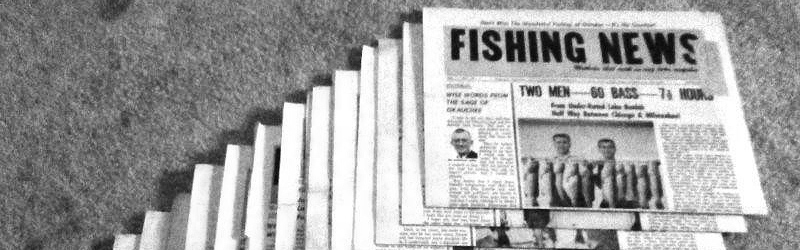
My brothers and I have vivid memories of the stacks and stacks of In-Fisherman Magazine that Grandpa collected. They were placed ever so carefully in medium-sized wicker baskets that lived next to the old wooden rocking chairs in the cabin up North.
Well… it was a “cabin” to us because it was in Wisconsin… but in reality, it was simply Grandpa’s “home away from Illinois”.
We loved it.
Dad taking us out into the channel to fish.
We also loved flipping through the pages of these beauties, imagining ourselves pulling giant pike, walleye, smallmouth bass and muskie up from the depths of the chain ‘o lakes – which would be extremely difficult at this time considering we all fished with bobbers, worms and a size 6 Eagle Claw baitholder hook right off the dock in about 4 feet of water.
(We never had cheap cartoon-character fishing poles, thankfully… Grandpa and Dad insisted we go straight to Zebco 33s.)
The covers though, I remember the covers. They were exciting and mysterious and I would flip through the pages looking for more pictures – not so much tips, advice and science. Science?! I got enough of that at school – this was about fishing!
Many great memories were made in the living room, but when anyone mentions In-Fisherman, I think about those wicker baskets next to the rocking chairs…
Grandpa’s Wisconsin house years later – similar, but at the same time very different… good memories.
The In-Fisherman
Al and Ron Lindner also used to vacation in Wisconsin as kids. Bass fishing started for them around this time, and Al avidly read Jason Lucas (who at the time was the only national figure writing about largemouth bass in Sports Afield magazine). While bass weren’t the only fish the brothers chased, this was still an important developmental time for the two young anglers.
We fished a lot in a little lake outside Hayward, Wisconsin, when I was about 5 years old. Ron and I didn’t have a boat, so we ran around in swim suits fishing lily pads and deadfalls from shore. We usually fished with frogs on weedless hooks. Later we used all sorts of artificials.
I remember two particularly big bass. One was a huge fish that Ron hooked on a Johnson Silver Minnow… we finally lost it, but I think that bass was 7 or 8 pounds, one heck of a fish for northern waters.
Another time, on the same lake, I tied into one on a Burke plastic worm with propellers. I lost it in shallow pads. Figure it was a 10. Even if I’m wrong, it was huge!
That lake turned me on to bass fishing. We fished for other species, but bass were exciting. I was pretty good with a jig and a worm when I was 10, long before worms were popular in the North.
Al Lindner
Those lost fish are the things that nightmares are made of… sleepless nights… wondering “WHY?! Why did she pop off?!”
Ron too, was knows to ask the question: “why?” He was a fisherman that loved the catch, but was fascinated by theory. In fact, in the book “Largemouth Bass in the 1990s: an In-Fisherman Handbook of Strategies“, it is said that Ron frustrated hundreds of fishing partners, fishing in screwball ways simply to test new theories.
Al on the other hand was more of a results-oriented angler, applying theories when they were shown to help him catch more fish.
These two personalities meshed together, one providing the yin to the other’s yang, allowing the brothers to probe the frontier of fishing in a way that no other single individual could.
In 1970, Al experienced lean times as a guide in the north during the ice season. He decided to make a move, and relocated near Sam Rayburn Lake in Texas. Rayburn was 5 years old at this time, and it was just hitting it’s productive peak – but Al still needed to learn how to target these winter bass in a huge southern reservoir.
He quickly learned just how important timber and creek channels were to bass location. With the help of other guides from Missouri and Arkansas, he mastered deep-water jigging. This method – along with many others associated with Rayburn – allowed the two brothers experience the effectiveness of lures that hadn’t yet reached the north.
By 1975, even though they had accumulated a large amount of knowledge, they had not accumulated a large amount of money.
They were broke.
So… what better time than now to start a brand new fishing publication?! It was out of this situation that The In-Fisherman Magazine was born. However, it didn’t look like the In-Fisherman we know today – the In-Fisherman that lives in those wicker baskets next to the rocking chair. No, Ron’s original concept was to create a small, focused correspondence course for a select few serious angling subscribers. However, by 1980 the magazine had evolved into so much more than that. It didn’t take long for the information the Lindners were bringing to the table to expand out into radio and television as well, forming the base of the In-Fisherman network. A network that would become In-Fisherman Incorporated, providing a powerful base for fishing education, sustained by contributions from powerful fishing educators.
Al & Ron Lindner
The network has always centered around collaboration, striving to provide authentic, useful fishing information provided by great fishing minds working together.
The development of general principles that aim to help anglers understand both fish and their world take center stage. Without these principles, the sea of “tips & tricks” can become a useless, overwhelming mass.
The network does not limit itself or specialize in a single technique, species or region. Instead, it seeks insight in all aspects of freshwater fishing.
From the beginning, In-Fisherman presented a more comprehensive picture of angling than had been the norm. Instead of focusing on “hot baits” or “hot lakes” and ignoring location and outside factors that could position fish, they provided a more complete picture and developed the formula: F+L+P=S
F (Fish) + L (Location) + P (Presentation) = S (Success)
Finally, by taking a more scientific approach to understanding fish and their environment while still focusing on catching fish (remember, Ron was all about the theory, and Al was all about the results), In-Fisherman was able to bring together recreational anglers, scientists and fishery managers – establishing itself as an authority and helping to promote sound conservation and wise fish management principles – all while teaching people how to fish.
Al & Ron Lindner of In-Fisherman & Angling Edge
As an adult, I am now a paying subscriber, just like Grandpa was years ago. Doug Stange (the current Editor in Chief at the time of writing) has done an outstanding job of keeping In-Fisherman on the cutting edge of the fishing world with continuous, high-quality information and articles. If you have never cracked the pages and had a look for yourself – I suggest you do so.
You might even consider filling up some wicker baskets and planting a few seeds for the next generation of anglers while you’re at it…
Some anglers look at tournament pros with pure disdain.
“I could outfish that hack!” “They’re messing up the spawn and ruining our fishery!” “Put summore patches on your jersy, you clown!“ “Must be nice to get your fishing boat and gear for free!“ “Great… camera crews… our lake is ruined…“
Have you ever heard anything like this?
… have you ever said anything like this?
While there is definitely a time and place for open discussion regarding fishing during the spawn, catch & release vs. selective harvest, and lake publicity – there is also reason to be thankful for tournament fishing.
In years past, different lakes & reservoirs would have a few local celebrities. Guys that could catch fish on any day at any time in their local lake. Many lakes still have these hot-sticks, but tournaments started to give visibility to versatile anglers from across the country. Guys that could travel and fish different bodies of water well – maybe not perfectly like the locals, but still very effectively.
Someone would always catch fish no matter what the weather was doing, or the time of year. This reduced the amount of “luck” needed for the recreational angler; luck started to be replaced with scientific and environmental theories that were being proven and refined again and again on the pro circuit.
This also allowed for the testing of new techniques, the sharing of information, and an overall better understanding of how bass would behave from region to region. We’ve all heard the phrase: “a bass is a bass is a bass“, but behind the scenes professional anglers were sharing (some) information and learning new techniques, then scrutinizing them. As publicity increased, the amount of money to be made increased as well. Tackle manufacturers could develop new rod & reel models that were species or technique-specific, new baits, new line – you name it – based upon the success (or failure) of certain combinations in certain lakes – and with the chance of national publicity, the incentive to innovate became massive.
Capitalism on display. And who benefits from capitalism? Us. You and me. The consumer. The better a product and it’s reputation, the more it will sell. Don’t let anyone tell you different.
If a company ain’t innovating – we ain’t buying! If we ain’t buying – they ain’t a company!
Certain patterns emerged as the best, fresh data was analyzed and put to the test, allowing those of us with “day jobs” (and therefore lacking 12 hours to fish every day) a chance to stay current with modern trends and developments.
Flippin’ for Bass
A famous example of this came from a The Texas Invitational B.A.S.S. tournament held on Toldeo Bend in 1977. Water temps were in the high 40s, and many of the prespawn bass were shallow in the murky water. However, right before the event, a cold front came through that caused the temps to drop in the shallows as the water clarity increased – shutting down the bass.
A competitor from California named Dave Gliebe won the event with 20 bass and an average weight of more than 4 pounds. Others soon realized that Gliebe had extracted his bass from heavy cover in shallow areas with deep holes (about 8 feet). These areas were covered in thick grass and matted, weedy “umbrellas” and heavy timber. The method of extraction? “Lever-jigging.”
Dave Gliebe Flippin’ for Largemouth Bass
Dave had learned “flipping” from his mentor, Dee Thomas, and had actually won two earlier tournaments using this technique and heavy jigs in timber. The “lever-jigging” variation was a 5/8 oz jig, flipped to penetrate the thick weeds, which was then allowed to fall to the bottom. The line from the mat to the jig was straight up and down, the line from the mat to Dave’s rod was angled. By pulling the line back and forth towards his location at that angle, the jig underneath the mat was allowed to raise and lower straight up and down. He would then work his jig for up to 5 minutes in a single location, waiting for a negative bass to strike.
The national press was impressed with how effective this method could be when other methods wouldn’t produce. Both flipping and “lever-jigging” had originated in Tule Lake (an intermittent lake covering an area of 13,000 acres) in California. Flipping presentations were known locally as “tule-dipping” or “doodle-socking”.
A handful of the other contestants were given a presentation on the technique after the tournament, including Al Linder, Ron Lindner and Roland Martin. These anglers soon spread the word, so much so that Roland Martin is more associated with the technique than Gliebe and Thomas. Ron predicted “there might be many other situations when this (basic) lure delivery system could be used.”
If you’ve ever caught a bass flippin’ a jig… take a second and thank the tournament anglers of years gone by. Chances are without the sharing of information and the development of new techniques, many of us in the Midwest and elsewhere would be unaware of the myriad of presentations that can – and do – catch bass.
Over the last several articles we have focused on individual men & methods surrounding the development of largemouth bass fishing. Pioneers like Jason Lucas, Buck Perry and Bill Binkelman, as well as Al & Ron Lindner. Let’s continue to work our way through what will be the foundation of our bass-fishing knowledge base: Largemouth Bass in the 1990s: an In-Fisherman Handbook of Strategies.
Largemouth Bass in the 1990s: an In-Fisherman Handbook of Strategies
During the 1960s and the 1970s, largemouth bass fishing exploded in America. So much in fact that the history surrounding this period actually becomes confusing. The sport that had been either dormant or developing slowly for the last 200 years blossomed at an alarming rate.
For starters, man-made impoundments across the country reached their fishing peak. (Quick sidenote: just this week I was watching a video where professional angler Randy Blaukat was thinking out loud, asking where all the big bass in Table Rock Lake had gone. In the comments section, someone claiming to be a marine biologist actually mentioned that reservoirs hit their peak at a certain time, then decline. The time for Table Rock? Many guys piped up and said it was in the 70s… still a great lake, they said, but you weren’t going to pull out 8 and 9 pounders with the same regularity of years past… if this is true, it aligns with what the staff at In-Fisherman was saying when they wrote this book.)
The first hydrographic lake maps showed general underwater features. Sonar let anglers fish these features more effectively and efficiently. (These days, we take casting our sonar units from the bank for granted!)
Zebco Model 33 Fishing Reel Ad
B.A.S.S. – The Bass Anglers Sportsman Society became the most dominant and influential force in the bass fishing world.
Tournament fishing started to become popular, and the success of tournaments – coupled with the publicity they offered – led manufacturers to produce better fishing tackle adapted to newly developed techniques. Developments in fibers & technologies led to new space-age graphite rods with advanced performance characteristics.
Tournaments also led to the development of better baits. The old Shannon Twin Spin was refined into the spinnerbait we still use today. Soft plastics multiplied as anglers developed more and more ways to use them.
The bass boat was refined into a fast, safe, comfortable “fishing platform”. To this point ‘ol aluminum 3-seaters were widely used. (That said… aluminum boats (jon boats or otherwise) still have their place!)
The bass fishing pro had become an influential fixture.
Underwater scuba diving pulled back the veil on underwater bass behavior.
Major biological studies of the black bass began, spurred on by the economic importance of bass fishing. Radio tracking of individual bass became available with new technology.
While this list may not seem that long – if you take a step back and look at everything listed here that we take for granted, it’s completely mind-boggling. It’s one thing to read a list of developments that took place over a 10 to 15 year period in any short format, but stop and really think for a minute:
Imagine fishing without your favorite rod and reel, your favorite soft plastic or a spinnerbait that would actually run true enough to be worked around heavy cover – without sonar, or even maps that showed the bottom contours of the lake.
We’d be lost for a long while – and I know this…
The fishermen of yesteryear, the ones that never had these luxuries, would probably fish circles around us.
If you’re looking to have some fun, take a peek at all the ways people used to market their goods and services. For example, the top of this book by Ron & Al Lindner:
Price: None, since this information is priceless.
Sounds too good to be true – I think I’ll get that!
One thing that many people don’t realize is that the Lindner brothers – while excellent fishermen – were also excellent marketers. Both men are engaging, they’re storytellers. You watch their fishing segments on TV and you feel drawn in, like you’re on a boat listening to an old friend.
Over the years, these two worked with many other anglers as they built the empire that would become In-Fisherman, and one of those anglers was Bill Binkelman. These 3 men made many important discoveries and contributions to the world of bass fishing.
Binkelman was an avid bass angler, although he was more widely recognized as an expert in walleye. In 1964 he was managing a large hardware store in Milwaukee. He became enamored with the advice of Buck Perry – advice that matched his own experiences on the water.
Thus, Binkelman briefly became a spoonplugger – after all, he had to stock cases and cases of the lures to meet the demands of his customers. He even promoted them through a newsletter published by his store, called “Fishing News“. Suddenly there were all sorts of “fishing secrets” being discovered!
Fishing News: Two Men – 60 Bass – 7.5 Hours
(Even more enticing marketing!)
However, Bill abandoned spoonplugs after concluding he hated motor trolling. He favored livebait presentations – and like Perry, also promoted structure fishing, combining the two methods into his own technique. He garnered fame through his walleye fishing, but Binkelman himself admitted he learned all of his walleye techniques catching bass.
In the early 1960s, Bill met Al and Ron at the store. He said that the two Chicagoland anglers were both “already skilled fishermen, especially with a plastic worm”, and the three men remained friends until Bill’s passing in 1989.
When Bill left the hardware store, he started “Fishing Facts” magazine. His friends Al & Ron were frequent contributors to the publication, and it became the first magazine to deal seriously with the concept of structure fishing.
Over time the magazine grew to be extremely influential, and through marketing and some fancy new illustrations (like underwater side-views and contour maps), it generated excitement and a hunger for new information and new techniques.
Buck Perry was said to be a loner. Jason Lucas – a loner. But Binkelman left a legacy as a collaborator. In time he worked on television shows, magazines, and additional fishing concepts like the calendar of seasons – although many would argue the adaptation of the spoonplugging technique to livebait was his greatest contribution to the sport of fishing.
He was truly a pioneer and a world-class fishing educator.
A chunk of bent metal adorned with some sort of painted pattern resembling anything from a frog to a minnow.
Buck Perry’s Spoonplug
The spoonplug was invented by Elwood “Buck” Perry after he spent time traveling and fishing in the south in the 1940s. The deep-diving lure not only served as a fish catcher – but also as a bottom-mapping device. By trolling rapidly with the spoonplug, Perry could figure out both the shape and composition of the lake bottom – and when sonar came on to the scene, he incorporated that into his system as well.
Chicago writer Tom McNally reported that Perry was catching amazing stringers of bass in the 1950s. His articles brought spoonplugging into the national spotlight, along with their creator. This method of trolling originally meant working a certain path or pattern with the spoonplugs, but later it was refined to mean fishing the bottom systematically to eliminate unproductive water.
“Deep water is the home of the bass”, Perry proclaimed.
This startled many bass anglers who had become accustomed to “beating the banks” and fishing visual cover. However, Perry’s claims were backed with alarming catches, and this persuaded many fishermen to begin focusing on offshore structure. His unique approach led to many arguments about who was the better fisherman: Buck Perry or Jason Lucas, but one thing is for sure – Perry had made a name for himself as the father of structure fishing, being the first fishing authority to give it focused attention.
Some of Buck’s theories seemed dogmatic in nature, others scientific. He talked about the shape of the bottom and it’s potential to hold fish. He said that bass live in schools. He turned attention to deeper water, and while a handful of anglers had proven him wrong on a few different points, his claims were always thought-provoking. They spurred growth. Growth that led to the development of the first logical theory for locating and catching fish.
Perry was a productive thinker.
Eliminate dead water. Locate the fish. Concentrate on productive areas.
Buck Perry and his Spoonplugging Book & Lures
Truer words have never been spoken. The spoonplug is still in production to this day, although it’s popularity has faded in time (being replaced by more modern trolling baits). Yet the principles and concepts that Buck brought to the table continue to form a strong foundation upon which anglers can identify the right water – with the right fish – at the right time.
Like the colonists that came to North America by boat years before, the outdoor writers of the 20th century (the fishing authorities, if you will) regarded bass as inferior to trout. In fact, they fished for bass simply out of professional curiosity.
“What is this coarse blackguard of a fish?!”, the Northeastern writers wondered.
Largemouth bass simply couldn’t compare to trout – the “sportiest” of all fish. However, between the early 1940s all the way through to the 1960s, outdoor enthusiast Jason Lucas started to publicly admit he was a bass fisherman. These claims continued throughout his career as the fishing editor of Sports Afield.
He fished trout too, of course, but within the pages of Sports Afield (one of the “big three” publications of the day: Outdoor Life and Field & Stream being the other two) he became an important spokesperson for bass.
In fact, he preferred bass, and he wasn’t afraid to say so.
He published a book as well, titled “Jason Lucas on Bass Fishing“, which became extremely popular and underwent major revisions, being released in three distinct editions between 1947 and 1962.
Lucas was also known to have a disdain for live bait fishing, which helped set him apart from the traditional fishermen of the day. He was said to be a bit of a loner, preferring his time to himself and often fishing 12 hours a day, six or seven days a week.
Clearly… those ain’t rookie numbers.
He was a fishing machine, and his work helped spearhead the effort to shift the national focus from trout to largemouth. Zach Taylor went as far as calling him the “pioneer of modern bass fishing”, releasing an article in Sports Afield titled “Evangelist of Bass Fishing: Jason Lucas”. In the article he proclaimed that this shift in species was fully realized when Lucas retired after 20 years with the publication, and it was helped in part by the demise of wild trout, which were replaced with “those paltry, hatchery-reared trout”.
Around this time Buck Perry had become known for “speedtrolling”, and anglers were taking massive strings of fish using this and other familiar presentations, like jigs and pork eels. Lucas was known to be critical of some of these new techniques, but one thing was certain: bass fishermen had arrived, in a big way.
When Lucas retired, the world of bass fishing had changed forever. Bass had been anointed:
Throughout the 1950s, the first sonar units built specifically for fishing made their appearance. They were expensive. They were difficult to use. They were clunky.
They weren’t popular.
In fact, a 1958 Lowrance Fish LO-K-TOR would run you as much as a Browning shotgun.
Lowrance Red Box Fish LO-K-TOR
However, as time passed the “Red Box” eventually became the famous (portable) “Green Box”, which worked well enough to become commercially successful. Soon after, others followed.
Lowrance Green Box Fish LO-K-TOR
Before the introduction of sonar, the surface of the water stood between fishermen and the world below. The world inhabited by the fish they were chasing. If the water was especially clear, anglers could see some objects below the surface, but in murky water the nuances below remained a mystery, and the same held true for deep water.
Early units were simply depth indicators, but improvements quickly appeared. Not to mention as anglers learned what the different signals (or signal strength) meant, they were able to identify bottom composition: mud, rocks, sand, based on what their units displayed.
This allowed bass fishermen that had primarily been limited to visible cover & structure, to confidently move into deeper water.
It also helped fishermen working the depths for other kinds of fish as well, by making underwater cover visible.
These humble beginnings were the building blocks upon which today’s super-advanced electronics were developed.