I’ve been gone for a bit – traveling (and fishing) with family, writing for a few new outlets, and just being blessed overall with some awesome new opportunities… but very busy. It’s time to get back into reviewing notes and fishing techniques that have worked well this year, and here’s an awesome little realization I’d like to share with you…
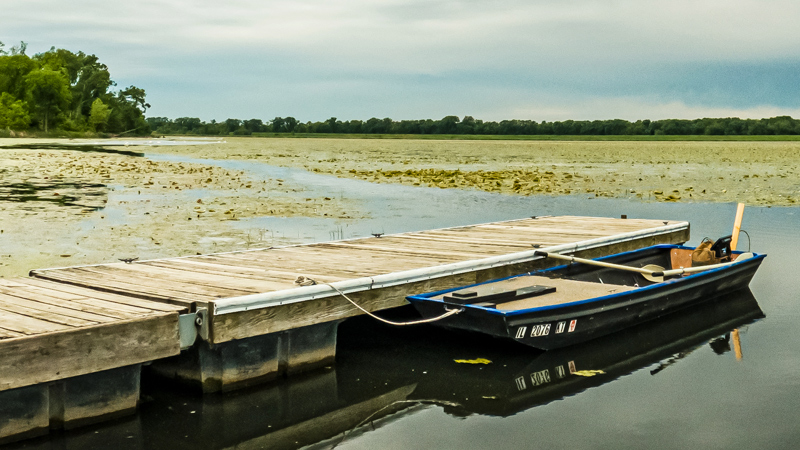
I’ve recently discovered there’s something different about a rowboat. Not just in how it moves – but in how it makes YOU move. How it slows you down. How it connects you to the water by removing things like electric trolling motors & sonar screens.
It’s different.
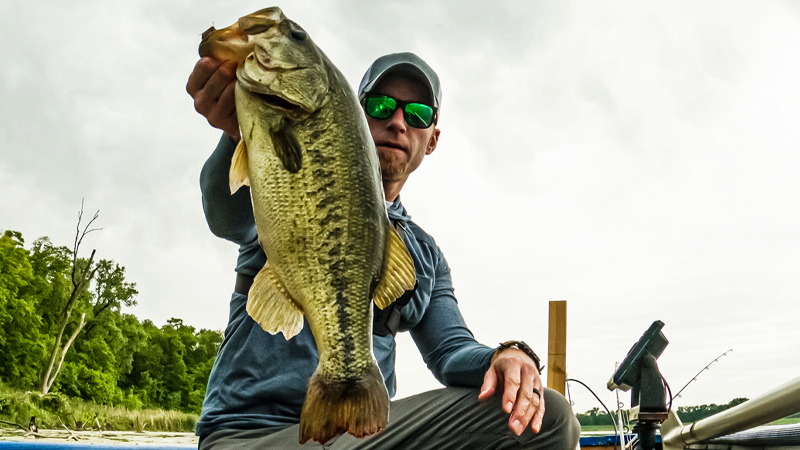
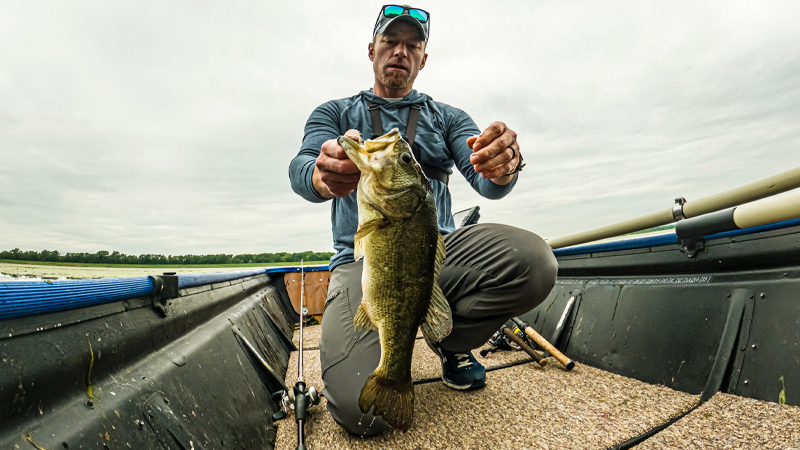
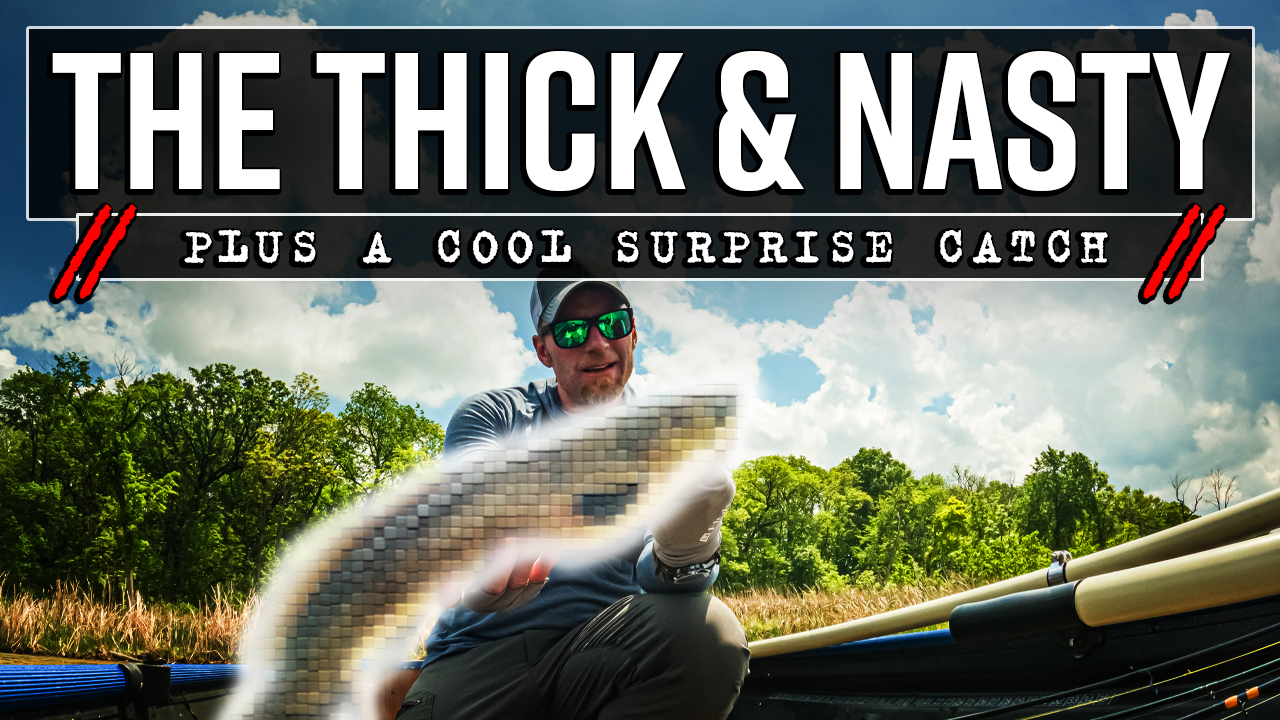
It’s also one of the BEST ways to gain access to big, hidden largemouth bass in the thick – and I mean THICK – stuff. Rowboat fishing is a physical activity and it will challenge your body in a good way, and after fishing everything from kayaks to charters to modern bass fishing boats that cost more than a house… there’s something special about stripping it all back. Drifting quietly with nothing but the rhythm of your own hands. Pulling big, fat bass into the boat from areas that NOBODY else is fishing, because their trolling motor would get eaten alive… yeah man, never thought I’d say it but… I love rowboat fishin’!
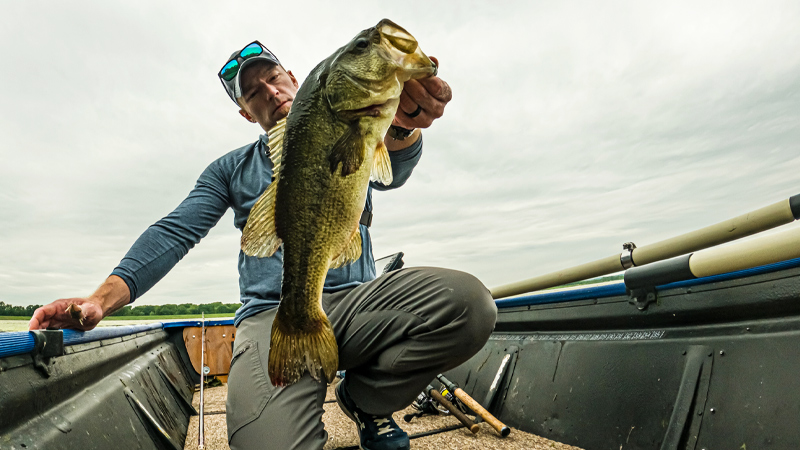
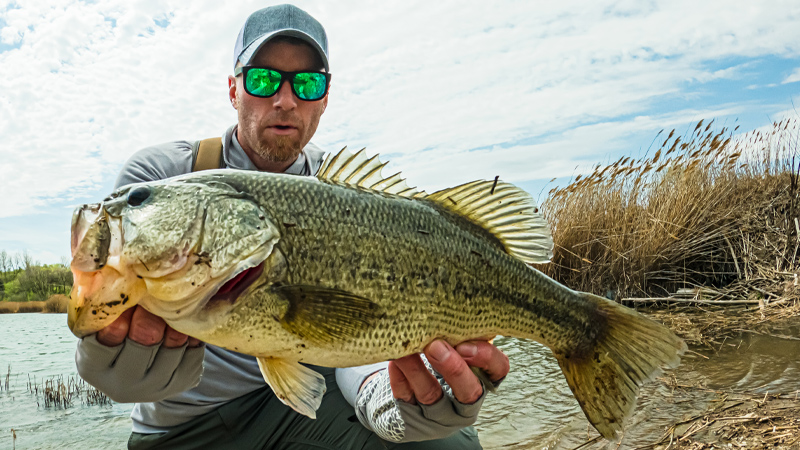
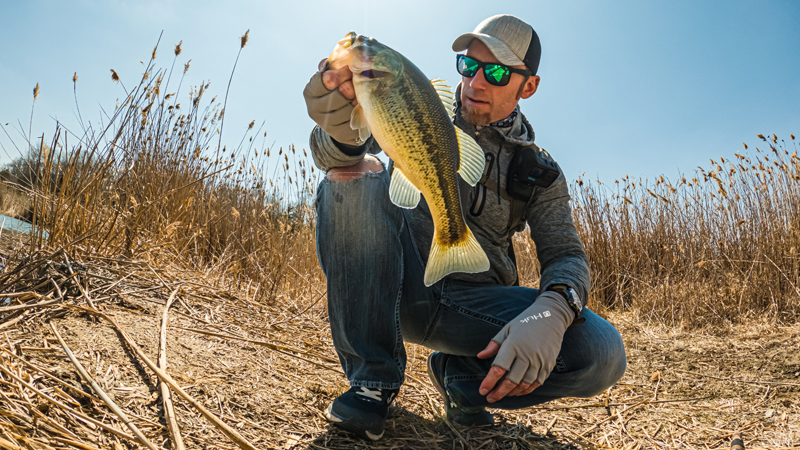
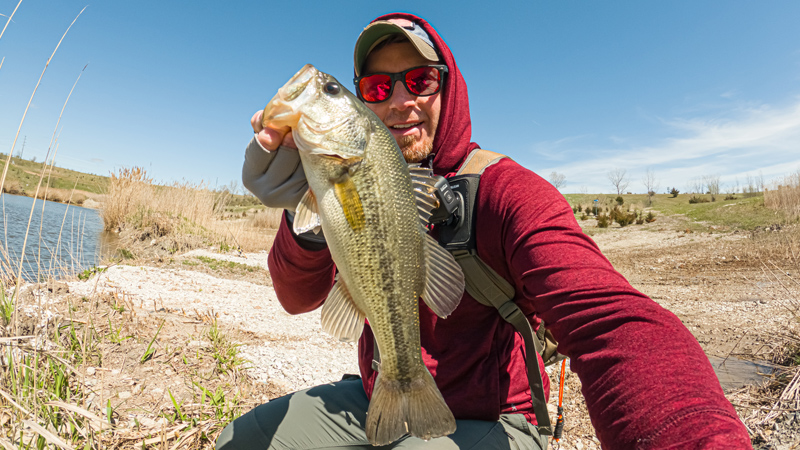
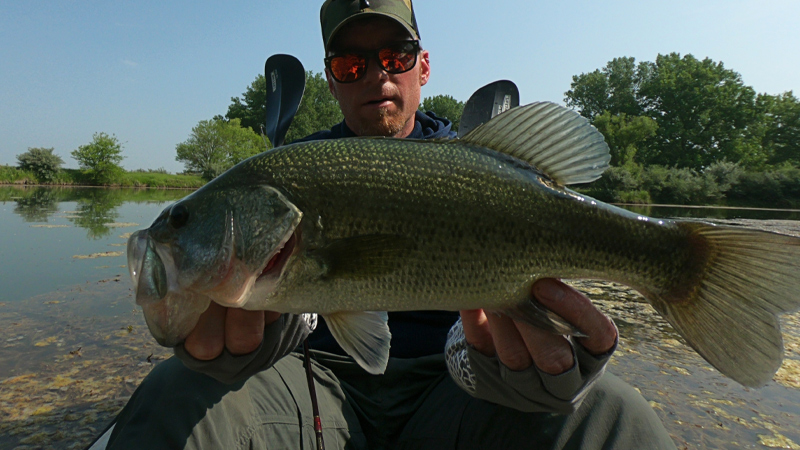
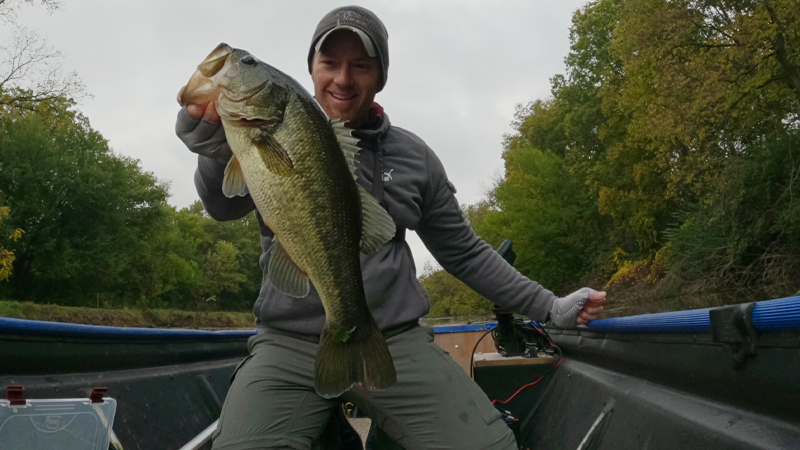
Big Fat Hidden Largemouth Bass Taken While Rowboat Fishing
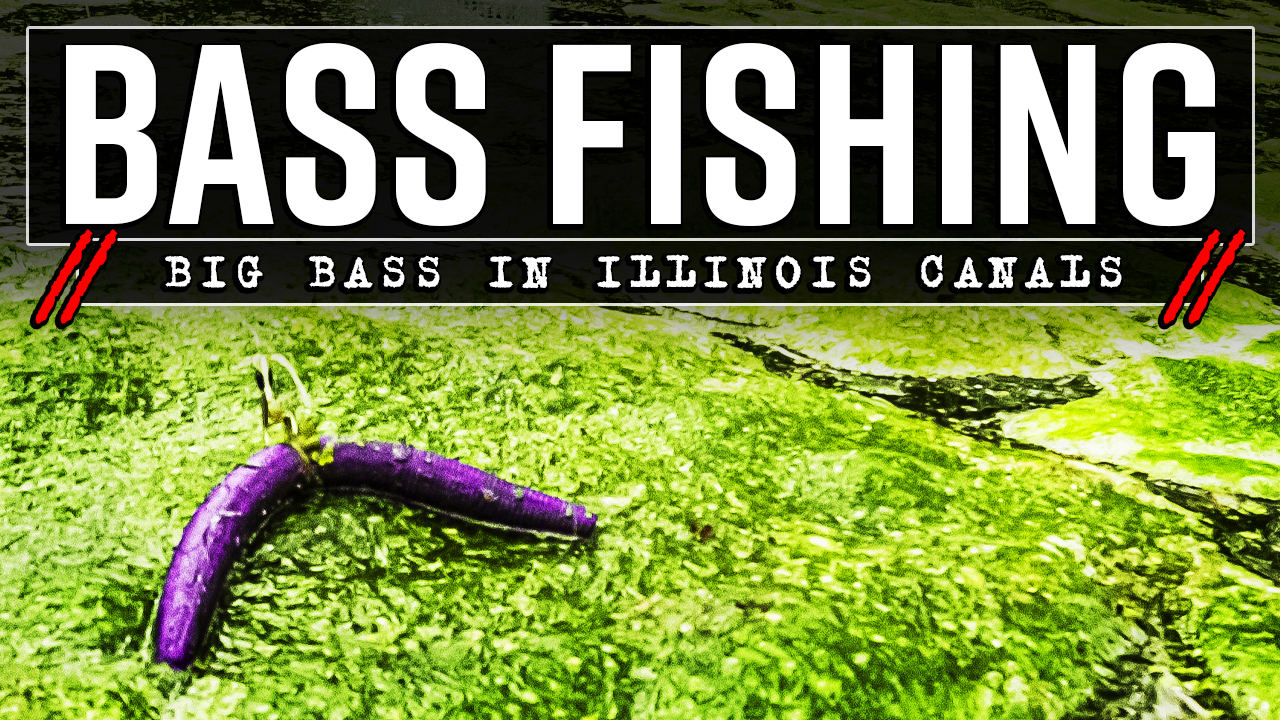
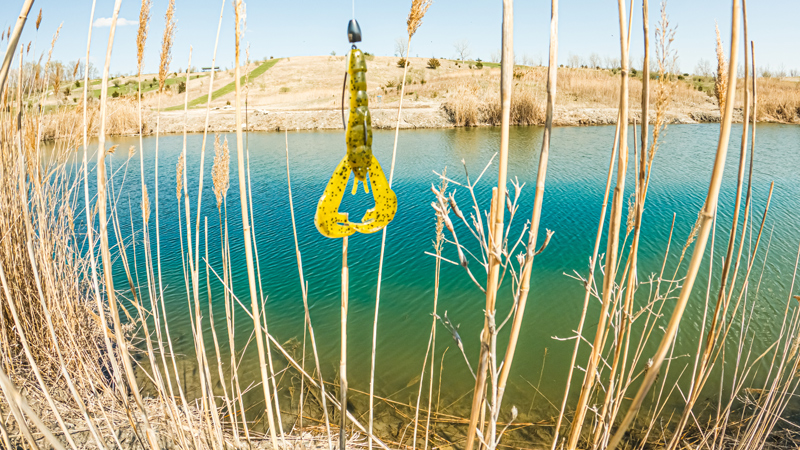
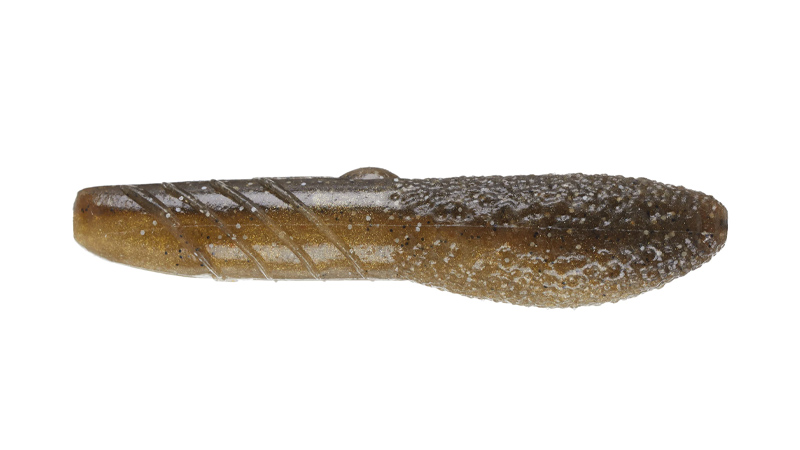
One presentation you absolutely for fishing thick stuff is The Crowbar Rig.
First, when it’s too dang thick to get around any other way! (I considered testing out a push-pole in here, but it was just too clunky and surprisingly expensive.)
That’s lookin’ a little… thicc…
Rowboat bass fishing shines on small to mid-sized lakes, but you could also use it to your advantage on bigger lakes with large, choked-out bays. It’s also great if you simply want to enjoy a more peaceful approach. You’ll see things you would’ve missed. Bass cruising the edge of a sunken log. A pike darting around the cabbage. Panfish suspending beneath the reflection of an overhanging tree.
Thick-cover water like this rewards patience, stealth, and presence – and this method of fishing forces you to pay attention to what’s in front of you.
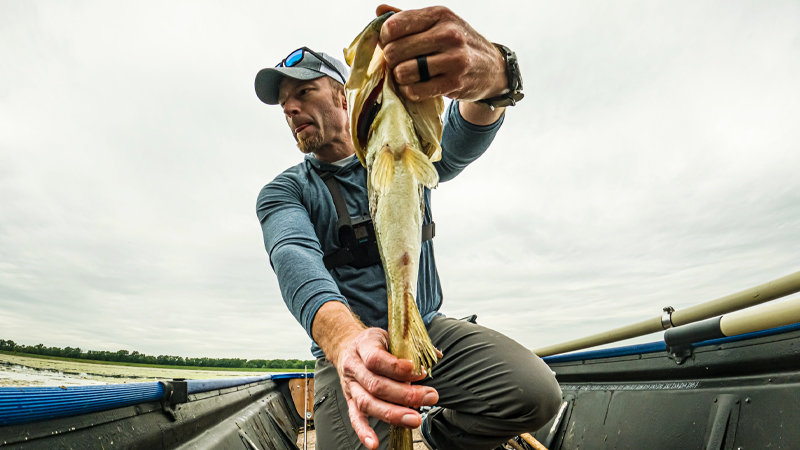
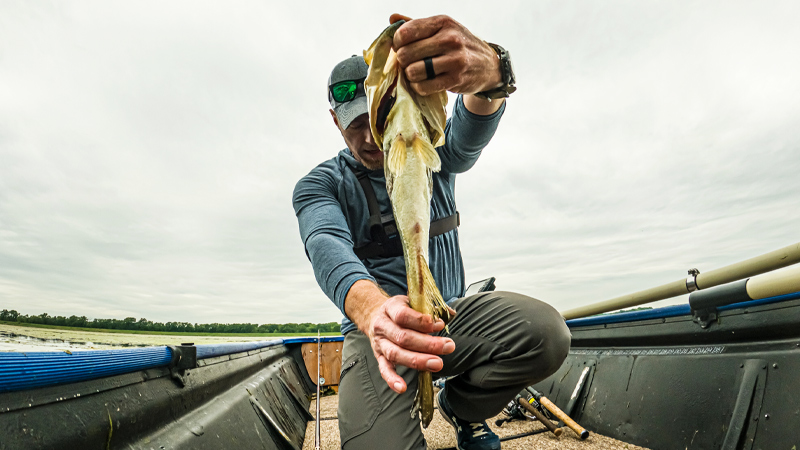
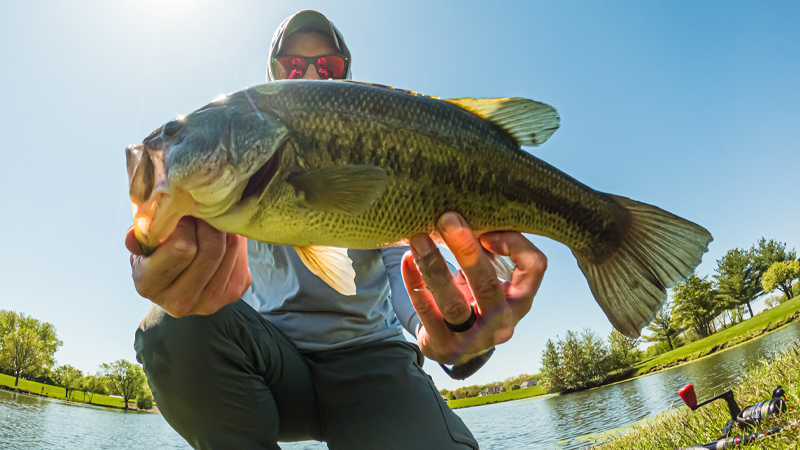
Rowboat Fatty – never woulda caught her without my little dingy!Another rowboat bass with some sort of deformity or sickness. 18″ long and way under 2 pounds – something was wrong with this one… not sure what…
Eat
– A –
Sammich
I’m not saying dump your electronics forever – but consider shoving off with nothing but a rod or two, a couple of oars and a small box of confidence baits. Fish slower. Enjoy the environment you’re in, get into the areas other guys aren’t exploring – and soak it up. It’s a different way to fish, and a different way to experience the water… and it’s GOOD.
Tight Lines & Godspeed, Patriots.
Get Articles & Videos First
Catch More Fish Than Your Friends. Laugh At Their Tears.
Your support directly funds the creation of weekly articles and videos that promote the development of better anglers and better men. Our country (and our kids) need both. Please share this site, and consider a monthly, weekly, or one-time donation. You are helping us make a difference!
The jon boat was finally ready, loaded, and trailing behind me as I sped toward my favorite canal. It was the fourth week of April, and even though it was a little brisk at 65°, it was comfortable. The only thing that made me uncomfortable… was the clouds up ahead.
But winter had finally released its grip on spring, and with the slight increase in warmth, life had to be stirring beneath the surface of the water. Clouds or not, I had to check. Within 55 minutes, the ramp came into view. I slammed the truck in park and walked over to the water to see how things looked…
Then the sky tore open.
Not a rumble. Not a flash. Not a drop of rain. Just a brutal, bone-deep crack of thunder following a streak of lightning so clearly visible it made the hair on the back of my neck stand straight up.
I didn’t launch the boat.
Instead, I cussed, got back in the truck, and drove all the way home. “What a flippin’ waste of two hours,” I mumbled… but about halfway through the drive, something changed. I went from sulking to planning. When you’re a father of five running two businesses, there aren’t many days you get to fish. So, my options were to be sad – or be flexible.
I opted for the latter. Dropped the boat, grabbed a different Base Box, a backpack, rigged two simple rods, and drove to a nearby group of small lakes with shoreline access. If I hadn’t… I never would have caught her…
Sometimes the best days begin with a little flexibility.
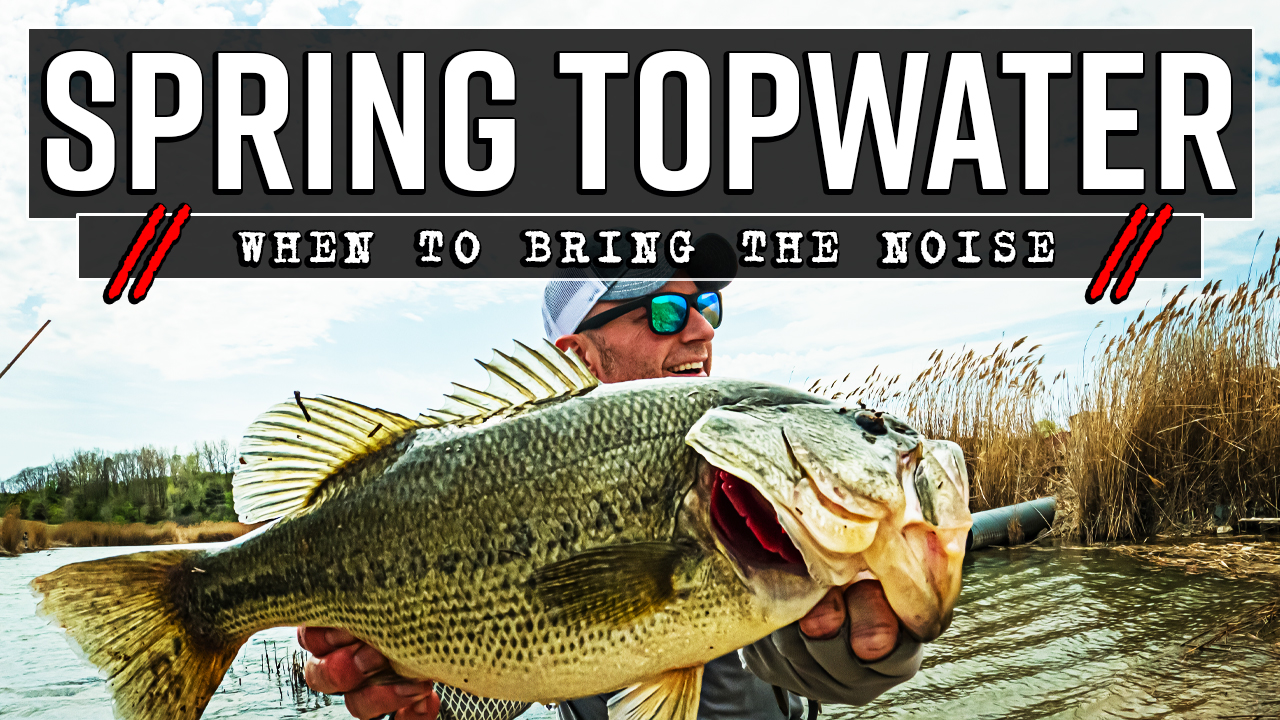
19″ of Pure Largemouth Attitude Exploding Topwater on a Crowbar.
In a nutshell, fishing flexibility means this: don’t force it.
The scenario above is true – you’ve experienced it yourself. We make plans to fish a certain lake, a certain way, for certain results. God laughs. Heartily. Then tells us otherwise. If we can pay attention to these signs – to our surroundings – we can usually make better decisions. Decisions that will make us safer, make us look smarter, and, in truth, help us catch more fish.
Rain? I’ll fish it. Clouds and even a bit of distant thunder? I’ll fish it. Lightning?
I’m out.
Don’t put yourself in a position where you are the tallest, most attractive thing on the lake – unless you’ve always dreamed of transitioning into a lightning rod.
“My pronouns are cooked / goose.”
Flexible Fishing Techniques
Leaving the canal was hard – not only because it meant I’d have to wait to explore an area I know holds big fish, but because I had to adjust how I would approach the fish at the next location. I had to pick somewhere I could take cover quickly, which meant staying on foot. This limited the rods I could carry, and so two bank fishing techniques got the early-spring nod:
1. Fling-a-Ding
I love throwing YUM Dingers around, but the problem with Flingin’ a Ding is that they have very little weight. They’re durable, cheap, and they catch fish – all good – but they look dead unless you impart some action into them. There are several ways to do this, but the easiest is to put your Dinger on a Reaction Tackle Weighted Wacky Jig.
Even in clear water, it seems like bass focus on the bait, not the weight. They’ll inhale your Frankenstein’d hot dog like it’s a gourmet offering! I’ll still opt for internal weights and super-light wacky hooks in pits with 500-foot visibility… but in semi-clear water like this, I don’t feel like I’m missing fish because of the exposed weight. Plus, the hooks are nasty, and the weight adds a pulse to the Dingers that is otherwise nonexistent. Very important. Very effective.
The color white (or in this case, a more subtle smoke / pearl laminate) is perfect for overcast days as it creates a soft glow in the water. At times, it’s the best thing you can throw.
Fling-a-Ding on Reaction Tackle Weighted Wacky Jigs
This setup was developed to pry big, mean bass from thick, heavy sludge. It’s a battering ram with a fishing license – like calling in an airstrike to deal with a raccoon problem. Brutal, yes – but effective.
The single hook delivers a much better hookup ratio than a frog hook – especially when you consider that the extra weight of the solid ElaZtech gets flung in the air less than a hollow-bodied frog. The legs give you the ability to buzz or pause. You can twitch, hop, skip, and everything in between. The fluoro is less visible and abrasion-resistant if you want to work around stumps and laydowns.
I could go on, but the bottom line is this: The Crowbar is an extremely versatile topwater presentation that I will leave tied on from the time the water hits 55° until the end of my season. Period.
It’s a flexible technique for the flexible fisherman.
Clear water? No problem. Buzz. Pause. Twitch. Brace for impact.
Crowbar Bass
Crowbar Bass
So yes, it can be frustrating… but if you focus on improving your flexibility – becoming a flexible fisherman – you’ll make better decisions, safer decisions, and make hay.
Tight Lines & Godspeed, Patriots.
Get Articles & Videos First
Catch More Fish Than Your Friends. Laugh At Their Tears.
Your support directly funds the creation of weekly articles and videos that promote the development of better anglers and better men. Our country (and our kids) need both. Please share this site, and consider a monthly, weekly, or one-time donation. You are helping us make a difference!
It’s early – but not too early – as you stand on the bank of the pond. To the novice, it looks empty. Calm. Still. Like nothing could possibly live beneath the dark surface… but you know better. The bright April days are slowly pushing the water past the chilly winter temps, and at 52°, things are waking up. The shoreline is riddled with the brittle brown stalks and faded reeds of last year’s growth. The chill in the air makes a jacket necessary, and as the wind picks up, it’s obvious why you’re the only one here. No matter – socializing isn’t on the agenda.
Even though the sun is up above the distant treeline, it’s fighting with the clouds, and your soggy fingers ache as you try to retie. A slight tug on a fresh Uni-Knot reassures you, confirming that the only connection between you and the fish is solid. It is – and so, the game resumes. Even though it’s early in the Midwest fishing season, it’s only a matter of time before your hard work pays off…
*tap*
The lightest tap. That’s all it takes to trigger years of vivid memories. In an instant, they all come flooding back – along with that familiar jolt of adrenaline that reminds you why we fish.
We’re off to the races…
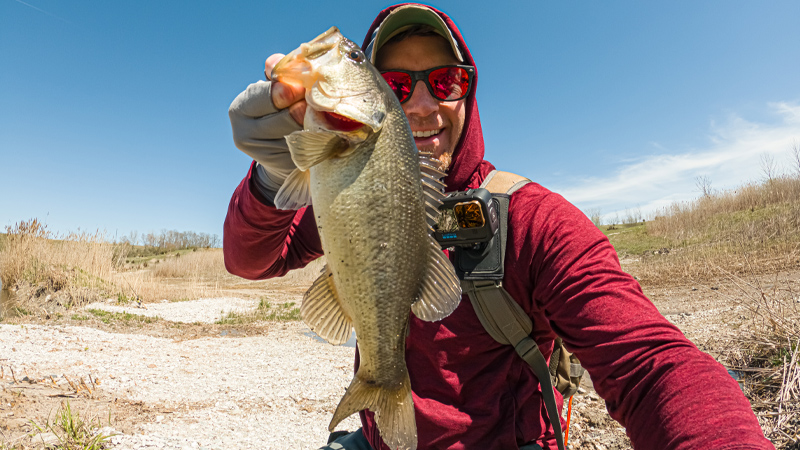
My first largemouth bass of the season
Bank Fishing is a Special Thing
For many of us, this was where it all began.
For those of us in the Midwest, this is where each new season usually begins.
Small ponds start to warm a bit faster than lakes and canals here in Illinois (especially those with deep water) which means more bass activity, sooner. What’s a “small pond”? Anything 10 acres or less. If you have good shoreline access, these are also great places to knock the rust off. If your timing is right, you can get into a good mess of fish. Not to mention, fishing during the afternoon early in the season can be the most productive window – no need to get up before the sun – you’ll get icicles on your bits.
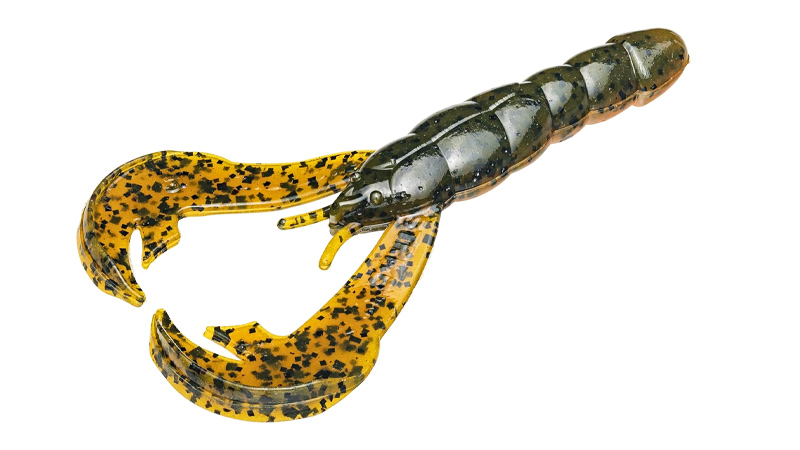
I tried several presentations this year: jerkbaits, chatterbaits, swimbaits, a bevy of ElaZtech plastics – but the Strike King Rage Craw turned out to be the most effective bait I threw, accounting for my first fish – along with the most fish – caught in April. Here’s a simple way to put it to work – and below, I’ll talk about pulling double duty with a single bait…
Minimalist. A Berkley Lightning Rod. Pflueger President XT. Reaction Tackle X8 Braid to a Seaguar Premier fluoro leader (abrasion resistant) to a 3/0 Gamakatsu Alpha Nano or Reaction Tackle EWG and a 1/4 oz bullet weight. With this, you can quickly cover ground and fish a single Rage Craw two ways:
1. The Rage Craw Vertical Approach
Cast it out. Let it sink without jiggles. Calm yourself. Watch the line. If you see it jump, reel down and set the hook! Bass will often snag it on the drop, and if they don’t, the flappies will get their attention. They will likely inspect your offering, and if they’re going to bite, it will usually be within a few “hops.” Slowly lift your rod tip, then drop it, allowing the bait to fall straight back down. Keep watching the line. Go ahead and jiggle it now, if you must – or go nuts and drag it along slowly for a few feet before you reel in to make another cast.
First Largemouth Bass of 2025 (1 week earlier) on the Vertical Approach
2. The Rage Craw Horizontal Approach
If you need to move faster and cover more water, or if you see positive signs and notice that the bass are a bit more active than you expected – there’s no need to switch baits – cast your craw, let it sink to the depth you think the fish are at, and begin a slow, steady retrieve. The flappies will paddle behind the swimming bait, and you’ll quickly realize that swimming is not only passable… but very effective.
Rage
Craw
Bass
I’m Sure You’re Asking…
“AJ… why in the world did you pair a $100 reel with a $40 rod?!”
Great question – it has a lot to do with where I fish these days. Between the canals and the shallow lakes that have to be paddled, knocking around in the brush, hauling my plastic kayak into the thick of it just to get a crack at unbothered bass… I beat my gear up a lot and feel much better about accidentally snapping a $40 rod than a $200 rod. These things are workhorses; good enough for this kind of fishing.
1 Bait 2 Ways = Faster Fishing, More Casts and More Bites
So get out there and get your flappies goin’. Remember that largemouth key in on vibration & noise, while smallmouth bass key in on sight & scent. Keep these things in mind as you start your season – and you’ll be off to a great start.
Tight Lines & Godspeed, Patriots.
Get Articles & Videos First
Catch More Fish Than Your Friends. Laugh At Their Tears.
Your support directly funds the creation of weekly articles and videos that promote the development of better anglers and better men. Our country (and our kids) need both. Please share this site, and consider a monthly, weekly, or one-time donation. You are helping us make a difference!
Tired of the wind? The chapped lips? The dark dinners? Heart-attack shoveling? Split fingers? The icicles of death? (See Die Hard 2 for reference.) The SUCK?
Golly man. I understand some of you masochists like to set up little tents and dangle the ‘ol worm deep down below the frozen ice. If that’s you, God bless ya, but I am absolutely clawing at the walls, waiting to get out and start the season off the same way I always do: Bank Fishing. I can’t wait for the dew to soak my shoes, the sun to cook my goose (I’m not sure what that means) and the bass to gnaw on my thumb.
“My goose is cooked!”
But as I worked through some footage from last April, I almost felt like I was doing something wrong…
Is Bank Fishing OK?
I’m a Midwest Fisherman, and in April we typically see water temps anywhere from the 50’s to the low 70’s. These temps fluctuate based on depth, wind and weather, but the bass are going to spawn. You can see them clear as day from the bank. They’ll be on beds. Or around beds. They won’t all spawn at the same time, and this can be confusing to anglers. Myself included. What triggers that spawn? Is it the temperature? The length of the day? Something else? A combination? The “why” is a discussion for another time, but the “what are you two doing in there?!” is pretty obvious…
Some beds will have “fry guarders” hanging around, some will have big, fat, beautiful females. Because of this, bank fishing (or specifically “sight fishing”) can be extremely productive… but there is a conversation to be had about a big problem with bank fishing for bass on beds…
I saw you… but you saw me, too…
These bass are up shallow, doing the hibbidy-dibbidy or guarding the results of said dibbidy. Giggity. But you know they have to be getting pestered all day. They’re just too close to the bank, especially in areas with lots of foot traffic.
You can see them. They can see you. The tension builds. Slowly, carefully, you pitch a half ounce Texas Rig with some outer-space-looking plastic thing that breaks the surface of the water with the subtlety of a cannonball. On ANY OTHER DAY, that bass is going to bolt – especially in such shallow water! But not today… today that bass looks up, annoyed, rolls her eyes and slowly does what she knows she has to do… she saunters over and slurps up your ridiculous offering (not having thumbs means in the mouth it goes, like a toddler) and tries to remove it from the clearing… SNAP!!… “I DONE GOT HER GEWD!!“, you bellow. She rolls her eyes a second time, allowing yet another goober to hoist her onto the bank, snap a picture, and (hopefully) put her right back.
Yes, I am the goober in this story. Yes, it is an exaggeration, but do you see the problem? On any other day that fish is going to run (swim) or at the very least, develop an immediate case of lockjaw as soon as they become aware of your presence. Could be your shadow. Your footsteps. Your B.O. (hopefully not that). I’m really struggling with the ethical side of this equation.
But… (there’s always a “but”) they are SO HARD to ignore. I mean look at this fish – how am I supposed to quit you!?
Everyone needs a few more heifers in their life…
Are bank fishermen “better” than tournament anglers? Are tournament anglers “worse” because they target bedding bass, throw ’em in the livewell, take them miles and miles back to to ramp for an official weigh in… only to release them there, instead of taking them back home?
(Pro-Tip: always plan a trip to go fish around the ramp a week after any local tournament wraps up. You can thank me later.)
Surely us bank fishermen aren’t that bad… at least not as bad as them… after all, we put ’em right back and that’s better… right? Hard to say. I don’t think it’s a question of “better or worse,” those are just shades of gray.
On the flipside: bass eat bass. Are we protecting the newly hatched fry that can’t protect themselves? When you consider both males and females eat baby bass by the mouthful… maybe we’re actually filling the role of a bassy savior?!
Hmmm… check this out and let me know what you think. Then I have one final question for you…
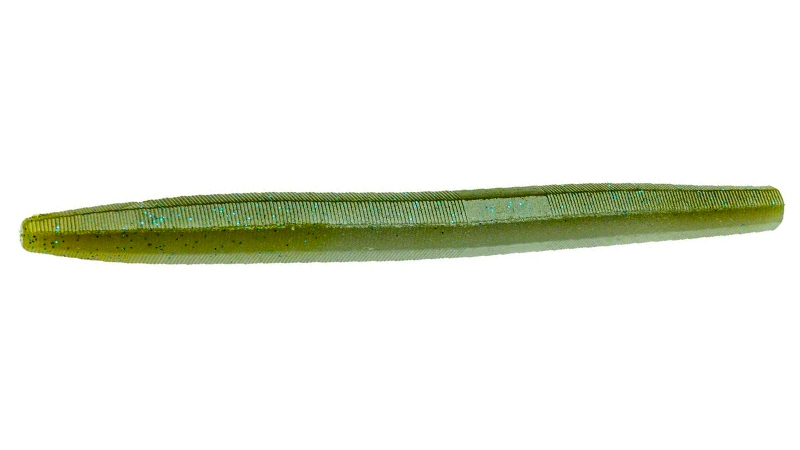
Quick Sidenote: the best bank fishing equipment is pretty simple. Stickbaits, first & foremost. Getcha some Senkos or Ochos if you want to fish weightless. Go with Dingers if you need to save a few bucks, but plan to use weight to add some movement to the lifeless plastic. Bang StickZ are a good option if you want a stickbait that will last all day and float, but again, they are lifeless on their own.
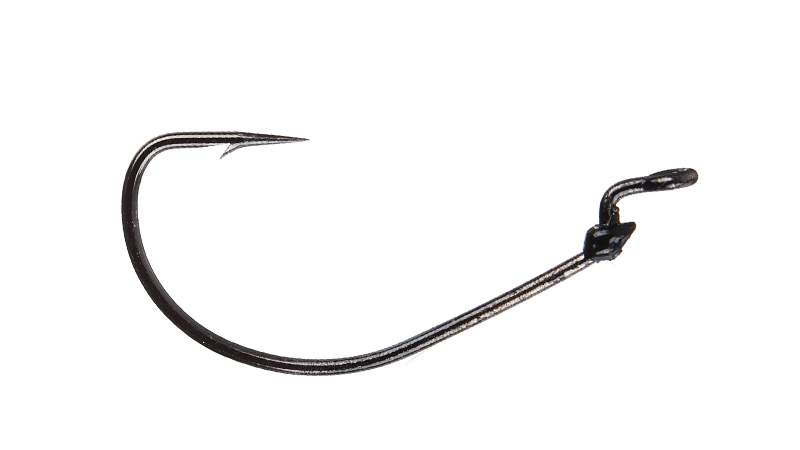
Hooks? The Trokar Pro-V is a NASTY little bugger. You hook ’em on these and they stay hooked – plus you can use up to a 4/0 and still stay relatively low profile with the baits mentioned above. The Magworm and the Grip-Pin are great options for stretchy morsels you want to lock in place (a la Bang StickZ), but they will tear “regular” plastics, especially those loaded with salt. Reaction Tackle makes a nice little bread ‘n butter EWG that is a good combination of strength and thickness. It’s not super-chunky, but you probably won’t straighten it out. I discovered Reaction Tackle years ago ordering on Amazon and assumed they were a foreign company, but they’re actually headquartered just 2 hours away from me – right in Big Bend Wisconsin, USA. If you want to reload the tackle box they have some quantity discounts worth considering, plus you can get 15% off of your first order. I plan to get up there for a visit later this year (and hopefully a video) to talk more with Cody Dobberstein & Chad Hoover. Good dudes!
So GEAR is always fun to talk about… but back to the matter at hand. Is bank fishing for bedding bass ethical? Is it OK? We all know it’s fun… but are we doing something wrong, or are we just enjoying a natural (renewable) resource?
I’m curious to hear what you think.
Hey buddy…
See you soon?
Warmer weather will be here before we know it. I’ve moved from sharpening hooks to loading the backpack and planning with great excitement in anticipation of some big, fat, springtime bass. Bank fishing is without a doubt one of the greatest ways to spend the morning…
Question is… do we bother them in bed?
Tight Lines & Godspeed, Patriots.
Get Articles & Videos First
Catch More Fish Than Your Friends. Laugh At Their Tears.
Your support directly funds the creation of weekly articles and videos that promote the development of better anglers and better men. Our country (and our kids) need both. Please share this site, and consider a monthly, weekly, or one-time donation. You are helping us make a difference!
It’s raining here in the Midwest. Rained yesterday, too… and the day before that. Honestly, it doesn’t seem like it’s stopped raining this spring. At night the steady drip-drip-drip of droplets cascading off the gutters is calming. Peaceful. In the morning there’s splattering and pattering on the outer sill of the windows as the sun tries so hard to poke her head out from behind the clouds sitting right above the trees across the way. Bright orange colors sit just behind, as the thunder slowly rolls in and sporadic flashes of lightning remind me – you’re not fishing today.
Hmmm…
Frustrating, but we live in a world where turbulence seems to be the norm… so small breaks (even breaks that Mother Nature forces us to take) are a blessing.
Soggy mornings like these are the perfect time to discuss simple improvements that anyone can make. Improvements that will help you catch more fish. I’m talking about The 80/20 Rule. No doubt you’ve heard about this ratio in some sense before –
“20% of the water holds 80% of the fish.” “20% of the fishermen catch 80% of the fish.” “20% of my tackle gets used 80% of the time.”
Some will even bump these numbers up to 90/10. You can pick whatever ratio you prefer, but today we’re going to apply this rule in a slightly different way…
Putting the 80/20 Rule to work In The FieldClick the banner to jump to Stars & Bars Fishing on YouTube.
Apply The 80/20 Rule to Every Base Box
Base-wha?
Base Box.
Get Articles & Videos First
Catch More Fish Than Your Friends. Laugh At Their Tears.
Over the years I’ve made many adjustments that help keep my on-hand tackle lightweight, compact and versatile. Minimalist. A Base Box is a single Plano container, pre-loaded with presentations that I have confidence in for a specific kind of fishing. Things I absolutely need to have for certain conditions. They’re always ready to go, so when ‘ol Billy Bob calls and says “BROTHER, LET’S FISH!,” I grab the appropriate Base Box, the Terminal Tackle Base Box, throw ’em in my backpack and head out.
Fishing from the bank? Just take that backpack. Fishing from a friend’s boat? Just take that backpack. Fishing from your own boat? Just take that backpack!
This helps me keep the clutter away. It keeps my mind clear so the focus is on catching fish, not organizing tackle. We’ve covered the Heavy Muck Base Box for targeting largemouth bass in thick cover, as well as the Wisconsin Bass Base Box for targeting smallmouth bass and other gamefish near Minocqua.
This year I’m working on a Muck Kayak Base Box, a Clear / Creek Kayak Base Box, and some others, but today we’re talking about how applying The 80/20 Rule to my Clear Water Base Box helped me turn a slow day into a great one!
First largemouth bass of the 2024 season.
Spring Bass Fishing in the Midwest
Here’s how the day went…
I decided to start small. Small, shallow ponds and lakes can warm up faster than large, deep bodies of water. This can translate into more activity, and more bites. One such puddle nearby, affectionately dubbed Snapping Turtle Pond, is home to some big bass… and big snappers.
Watch your toes!
Not all bass spawn at the same time. Smaller, warmer lakes might be the earliest to see spawning activity. I don’t target spawners, but paying attention to the local calendar period will help you find active biters. For example, if a very small lake gets the postspawn blues, head to a larger lake and see if you can find prespawn fish looking to chow.
The afternoon bite can be best in the spring. Midday, when the water is warmest and the sun is high in the sky, it’s not uncommon to experience the fish “turning on,” which means you don’t have to be up and out before dawn.
Moving baits can work in cold water. I decided to start with a 3″ swimbait, and follow that up with a 4″ stickbait in a natural green pumpkin color. Here were some key items in my Clear Water Base Box:
I fished for 2 hours without a bite. Tossed the swimbait, then the stickbait (again both in natural colors). These are confidence techniques for me… and they came up blank.
The water was chocolate milk. Probably from all the recent rain and runoff. I even had a 12 pound fluorocarbon leader tied to my braid because I thought they were going to be able to see my line. Not the case… and actually, I don’t think they could see much of anything.
Fortunately I had already applied The 80/20 Rule to my gear. 80% of my equipment was focused on clear water techniques. Natural colors, natural patterns, natural movement, small or invisible line, and exposed hooks. (Think crankbaits, topwater poppers, lipless cranks and natural plastics on jigs.) However, 20% of my equipment was focused on the exact opposite… and thankfully, I had the high-vis low-snag option you see here:
“Here I come to save the daaaaaaaaaaaay…”
A Coppertreuse Hula Stick (soaked in Dr. Juice attractant to mask human scent) on a Texas Rig with a Mustad Light Wire Grip-Pin hook and a 1/16 ounce tungsten Nako bullet weight. This saved the day, because the conditions were not what I expected!
#2
#3
#4
On my very first cast with the high-vis presentation, I caught a fish. Same thing happened on the second cast! We ended up catching five fish (and missing one) this afternoon, with four of them being right at or over the 2 pound mark. All bites came within a 40 minute window on the wind-blown side of the pond.
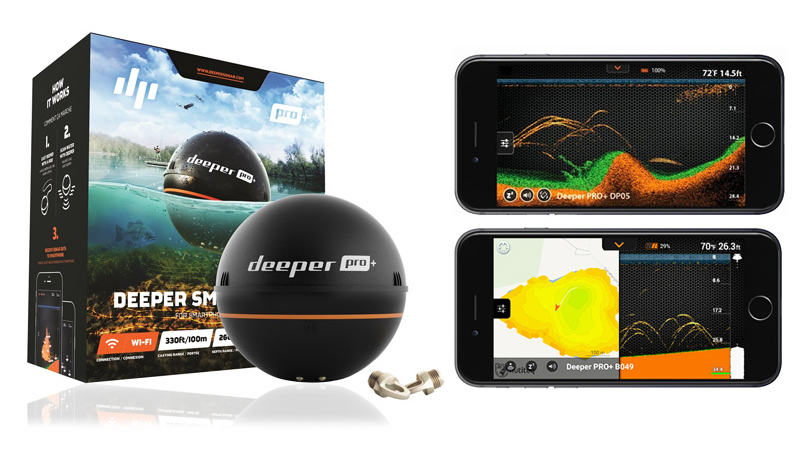
I had almost given up. Even took a 30 minute break to map with my Deeper Pro+ Sonar to try to “salvage the awful day.” But it wasn’t awful. The answer wasn’t to quit – the answer was to adapt.
If you apply The 80/20 Rule to your tackle, you’ll be more prepared for anything that comes at you, without needing to carry around the entire tackle shop. Take a minute to review what you have on hand, and maybe make a few changes.
This can be the difference between a complete bust… or a great day of fishing!
Want to go even deeper with 80/20 fishing? Check this video out:
The Base Box Concept + The Best Way to Use The 80/20 Principle
Tight Lines & Godspeed, Patriots.
Get Articles & Videos First
Catch More Fish Than Your Friends. Laugh At Their Tears.
Your support directly funds the creation of weekly articles and videos that promote the development of better anglers and better men. Our country (and our kids) need both. Please share this site, and consider a monthly, weekly, or one-time donation. You are helping us make a difference!
It’s early morning here in the Midwest. A bitter chill hangs in the air. Frost has come. Snow will soon follow. The sun slowly creeps over the horizon and the blurry orange light it brings with causes eyes to squint. Refocus. Adjust. Small misty clouds become visible, as warm breath after warm breath condense on the frigid morning air…
Well… not MY breath…
John’s breath.
Who’s John?
My neighbor. Out for his morning run. Getting after it. “Wow… good for you, John…” I mumble, while looking out the window and indulging in another glorious slurp of piping-hot coffee before turning back to my desk… “Not really my thing… but… good for you…”
I have other plans this morning… it’s time to invest.
No, not in the traditional sense. We’re not dollar-cost-averaging, or looking into the latest crypto-craze. Not shopping for stocks or mutual funds – we’re investing in bass.
Big bass.
Some fellas ice fish, and that’s probably a lot of fun – but with 2 jobs, 4 sons and a lovely wife, I prefer to save up my “fishing credits” and cash them in throughout the warmer months. Winter in our house is a time of recuperation. Upkeep. Grandpa Hauser taught me long ago that instead of sitting on your hands, you better be sharpening hooks and oiling reels! Sound advice for sure, but prior to last season I learned a few powerful tips that helped me catch more fish. Bigger fish.
They’ve become recurring investments I make into my bass fishing season.
… and the best part?
They don’t cost a dime, and the returns are outstanding!
AJ Hauser with a 4 pound largemouth bass taken from a small, hidden – and yes, public – pond in Illinois discovered using these simple techniques.
Let’s jump in.
1. Pick Several New Bodies of Water to Visit Next Year
First and foremost – it’s time to select some new bodies of water to explore this coming season. Get comfortable with the DNR website in your state. If they list fishing locations, pick a few.
Where I live, the Department of Natural Resources offers I Fish Illinois, and while the site looks a bit antiquated, it’s absolutely loaded with information. On the main page you can select one of 5 regions, which quickly filters the links. From there, you can click to access data on county, acerage, ramp availability, boat restrictions, recreational opportunities and the fishing outlook for the year. You’ll also see a bit of history, the local contact information, fishing limits and yes – stocking information.
The I Fish Illinois website offers a ton of information, and it is a great place to invest some time this winter.
Last season, this tool helped me identify new water that looked good within 90 minutes (the maximum distance I was willing to travel one way for a day of fishing). When spring hit, I still fished all the old honeyholes, but also made a point to get out & explore these new locations. It was exciting, and having created a list in advance made it very easy.
My winter research led me to beautiful areas I didn’t even know existed.
2. Utilize the Eye in the Sky
The Googlebox is always watching… is that creepy? Yes. Is it useful?
Also yes.
Before heading out, explore new terrain from the comfort of home. Open Google Earth and plug in any new location you plan to visit. Look for visible cover, as well as points, pockets, islands & coves. If you’re considering winding water, you’ll be able to identify bends, jams, riffles, runs & pools. This gives you a leg up and will help you hit the ground running!
But wait, there’s more. While satellite images are great, treetops can hide all sorts of goodies down below. Switch over to Google Maps and look for little blue blobs. That’s water. Mark those. If you’re in a state park or SFWA, I strongly suggest you check if you’re able to hike and access these less-obvious bodies of water, either from the shore, or in a small kayak.
When used together, Google Earth and Google Maps can help you find hidden gems that would otherwise go unnoticed.
We’ve all experienced the increase in fishing pressure on many popular lakes that are easy-to-access. It’s great that more people are getting outdoors, but frustrating when “our lake” starts to get crowded. Investing a bit of time to find new, hidden areas can be very rewarding!
It’s likely the little body of water over yonder doesn’t see much fishing pressure…… but the fish are there.
3. Seek Out Blogs by Local Anglers
We all like to brag about our catch. Pictures and stories can be seen all over social media, but by themselves… pictures are not very helpful. Last season, I noticed several public blogs written by nearby fishermen. All I had to do to find them was add keywords like “blog” or “fishing report” or “fishing news” when searching for the name of the next new spot I planned to fish.
Then, I’d comb through the results. Some blogs were current, while others were digital artifacts from years ago – but all of them contained information. Many of the angling authors clearly used these blogs as a place to store notes for themselves – but didn’t mind sharing.
This allows us to play detective, piecing together clues and matching bits of information to the assumptions we’ve already made in our mind after viewing satellite images. Very useful.
This small backwater area was mentioned in a blog, hidden by shoreline overgrowth. After reading the post I pulled up the satellite images and sure enough – there was a “blue blob” I’d missed...… it ended up being a great place to drag the jon boat and spend the morning!
4. Look for Local Forums and Facebook Groups
As you prowl the web looking for blogs, you’ll likely come across local fishing forums, or perhaps a Facebook group or two. Join them. Contribute! These can also be rich with information.
One thing to keep in mind though: I mention them after blogs because they typically tend to be centered around larger bodies of water. Bodies of water with more fishing pressure and pleasure boaters. If you’re seeking remote areas, you may find a few breadcrumbs worth following, but I tend to use them to get a feel for the bite and current conditions – then use the tips above to find hard-to-reach areas where a kayak or jon boat can slip away from the crowds.
Larger lakes can be very productive. My jon boat can’t compete with speedy bass boats or forward facing sonar, but pre-trip scouting helps me avoid the crowds & fish alone in hidden areas.
5. Talk (and Listen) to People
The last tip is the only one that will require you to leave your cozy home: get out and talk to people! We all know boat ramp etiquette is a must. Casual conversation by the lake can be enjoyable & informative… but take it a step further. Keep your eyes & ears open at work, church, school functions, the grocery store – everywhere – and I bet you’ll pick up a few more fish.
For example, earlier this year several workers were applying new blacktop in front of our house. While driving through, I thanked them for stopping so I could pass, and one commented on the kayak hanging over the side of my truck. After a polite back and forth I offered up where I was going, and he returned the favor, sharing one of the places he liked to fish.
Mental note. Check.
Later that week I took a quick trip, and you better believe a bruiser of a bass hopped right into my kayak! (I’d be willing to bet the worker did just as well at the place I mentioned to him. Win-win.)
Thank you for the tip, Mr. Worker-Man.
Here’s one more quick example: Last season the DNR “carded me” 3 different times. Each time, we had a polite, pleasant conversation. During the last one he said:
“You know… I see you in this jon boat all the time, have you ever taken it into the canal? Lots of guys have good luck there and it’s really shallow with tons of stumps and laydowns. Seems like the perfect spot for the kind of fishing you do.”
He was right.
A few simple conversations put me on some nice fat largemouth that I had driven by hundreds of times – they’d been sitting right under my nose all along!
I ended my season fishing in an area I had never even been to before, and these fish (plus many more) came as a result of talking – and listening – to others.
So, Fellow Anglers – Invest!
There’s always something to do. Something we can improve. It might be our gear, our storage setup, or any number of tasks and upkeep, but if you long for warmer days in the Midwest don’t just sulk or sit on your hands.
Take some time to invest in future fishing returns – you’ll be glad you did!
Tight Lines & Godspeed, Patriots.
Get Articles & Videos First
Catch More Fish Than Your Friends. Laugh At Their Tears.
Your support directly funds the creation of weekly articles and videos that promote the development of better anglers and better men. Our country (and our kids) need both. Please share this site, and consider a monthly, weekly, or one-time donation. You are helping us make a difference!
Here’s a fun question: will Minimalist Fishing lead to your next personal best?
Yes.
Full stop.
Oh really??
Why Does Minimalist Fishing Leads to More PBs?
The primary tenet of Minimalist Fishing is to constantly optimize. Optimize yourself, optimize your knowledge, optimize your experiences, and finally – optimize your gear. Gear is mentioned last on purpose. The emphasis is on getting better in every way – not becoming a collector.
The gear we use (think baits, rods, reels, boat, electronics…) is not as important as the know-how.
What good is any tool, without the knowledge to use it?
What good is any weapon, without the experience to wield it?
By focusing on the (dull!) education & theory surrounding fishing, instead of the (shiny object!) nifty new baits – we become better anglers. New tools are cool… they’re addictive and fun to buy… but they come second. Do not put the cart in front of the horse.
If you embrace Minimalist Fishing, you will probably start to enjoy learning, build a stronger foundation – and beat your PBs. I guarantee it, and I’ve seen it happen twice this year alone.
It ain’t rocket surgery… but it is an ongoing (extremely enjoyable) process. Sign up below and I’ll send you emails when new articles & videos post, so you can start to build a stronger foundation right alongside us – and hopefully, contribute to the conversation as well.
You’re Welcome in our Camp
Add your email below and we’ll keep you up to date on new articles, videos & events. Join us as we continue to work on becoming better anglers – and better men.
It’s never too late – or to early – to start.
My kids have all caught more & bigger fish than I had at their age… that alone is worth the time & effort. You can do the same for your family.
Tight Lines & Godspeed, Patriots.
Get Articles & Videos First
Catch More Fish Than Your Friends. Laugh At Their Tears.
Your support directly funds the creation of weekly articles and videos that promote the development of better anglers and better men. Our country (and our kids) need both. Please share this site, and consider a monthly, weekly, or one-time donation. You are helping us make a difference!
Periodically readers will contact me to share tips, tricks, strategies – even send me physical gear and lures for use & review. This is really cool, because when someone takes the time (and pays for shipping) to share something they like – I take it very seriously. Brother Ron D and I have had many discussions regarding everything from family to technique – and I’ve posted a few because I feel they are beneficial for you as well. For example:
Like Brother Ron R. says: “It’s not an EXPENSE it’s an INVESTMENT!”
Let’s look into a few other emails that I saved from Ron D where he shares some of his clever bass fishing bait modifications… this is all good stuff. Check it out:
AJ – as usual, your reply is intelligent and thought out. The Pop ShadZ and Hard Leg FrogZ are indeed great recommendations. However, I’m purely ultralight, so throwing around 4″ – 5″ baits is not part of my fishing ethos.
As mentioned, the FrogZ for not being a popper “pops” nicely when jerked correctly and makes splashes. However, if you need more splash, find a used plastic container (juice, pop bottle, take out container lid, etc), cut out a dime sized circle, heat a nail and punch a hole through. Voila! Any Z-man floating bait (even worms) is now a popper! Feeling particularly artsy-fartsy and creative? Take the plastic and try different shapes. Or heat it gently and press it into a rounded surface (I prefer the rounded head of a ball peen hammer) to make it more cupped. Maybe you and the kids can do this for arts and crafts day!! Feel free to try this and report back.
Ron D. Homemade Popper Modification. Clever.
As far as the Chatterbait goes… ya…it’s not a lie that thing likes pond muck. But it’s fine for going through weeds. Many people get the bulk of their hits after pulling it to unhook in the weeds…that change of pace/sound is what gets them apparently.
I think it’s “better” in dirty ponds/channels where muddy or stained water is present. The fish can’t see as well, so the added chatter is like having a swim jig deluxe model! LOL… but as you point out, the blades can be muck magnets if those conditions occur. To alleviate this, I’m using the smallest Chatterbait Micro, 1/8th ounce. I have it topped with a cut down Hula StickZ in “The Deal” color. As you can see in the photo, the blade is scarcely larger than my thumbnail.
The crappie sure did like it and the bass too! But as with any tool in the box, you need to use it correctly and appropriately.
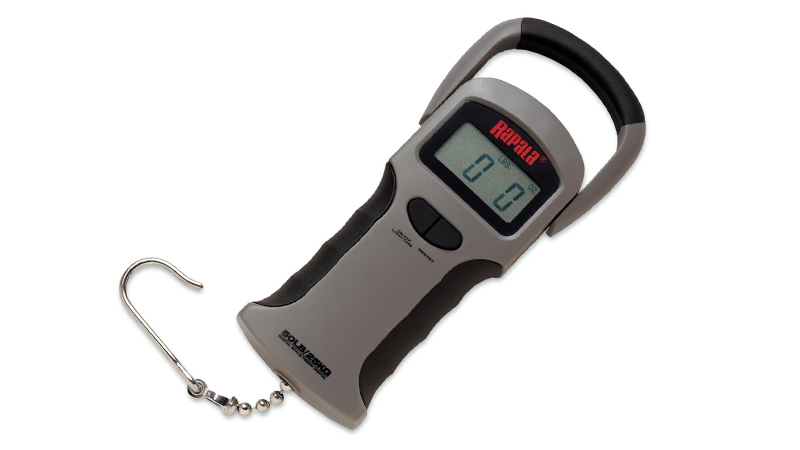
A Better Fishing Scale?
Here is what I use… it’s a digital luggage scale. It’s accurate. It’s compact. It’s inexpensive. Maybe $10 plus $2 for a spring clamp?
I know that second tip was kind of random – but dang it – it’s clever! I just ordered a Digital Luggage Scale to use for weighing fish, and when it arrives I’ll test it on some different weights in the basement to see how accurate it really is.
As always, if you have every contacted me in any way – thank you. If you’ve ever shared gear or donated, thank you. My goal when I started this website was to meet some new friends that I could learn from, and discuss fishing with. Nobody has a lock on knowledge last I checked, and in every situation we can learn something.
Hopefully I’m able to share more as people contact me, and the rising tide will raise all ships.
Tight Lines & Godspeed, Patriots.
Get Articles & Videos First
Catch More Fish Than Your Friends. Laugh At Their Tears.
Your support directly funds the creation of weekly articles and videos that promote the development of better anglers and better men. Our country (and our kids) need both. Please share this site, and consider a monthly, weekly, or one-time donation. You are helping us make a difference!
Please note: my wife did not secretly write this article… truthfully, she doesn’t really say anything about my fishing expenditures… because she benefits from them as well (see The Ultimate Minocqua Fishing Guide for proof).
She also knows that I love here – but I wouldn’t listen. She knew who I was before she married me. I knew who she was as well.
As it should be.
That said… we are still a team, and it would be irresponsible for me to just spend money willy-nilly. However, I did do something kinda goofy over the weekend… after making small monthly investments for well over a year now… I was finally able to… put a $1,600 trolling motor on a $200 fishing boat.
And no… it’s not paid in full… I’m still financing the balance over the next 12 months… so hopefully it doesn’t break before then! 😀
(Allow me to take a moment to say a big THANK YOU too all readers that make monthly contributions to The Minimalist Fisherman. You help to fuel this endeavor, and are so appreciated!)
The reason for the upgrade? Well… the Powerdrive has a feature that allows you to record a path as you travel it, then later, run that same path automatically. Hands free. Forward and backwards. As someone who fishes little lakes by himself with very limited time (*cough* 4 kids 2 jobs 1 happy wife *cough*) this will help me cover more water with my active presentations. I will be able to create paths based on the best looking structure I find while mapping the bottom with my Garmin Striker Vivid 9sv – another crucially important tool that helps me review the bottom after I get back from a trip, and learn more about a body of water, faster.
These tools cost a fair amount of money.
So how much is TOO MUCH when it comes to buying fishing equipment?
I’m reminded about a conversation I was having with Brother Ron D. As you may recall, Brother Ron D had some valuable insight on Fishing With Light Line that we discussed in an earlier post.
That was a great discussion – and we recently had another regarding the immense explosion in popularity, but substantial cost of Japanese plastic fishing baits. Specifically, Spinnuts, DoLive Beavers, Yamatanukis and the now infamous Cover Scat.
That conversation ties in perfectly with the discussion about my $1,600 trolling motor for the $200 jon boat… it’s all related… and it went a little something like this…
From Brother Ron D –
AJ, I am having a difficult time processing what has happened over the last few days. It has, somewhat, been a revelation. It has changed my perception of what a bait is…and how fish see them. I’m still trying to come to terms with this. Let me explain.
There was a bait I refused to buy. For a couple years now. I thought it was STUPID, expensive, not durable and also… STUPID. But a couple of things happened.
First, I discovered the Hayabusa Spin Muscle Hook I sent you. Truly exceptional in all regards. So that led me down the road of looking at some JDM (Japanese Domestic Market) baits, particularly those designed with the Free Rig or Jika in mind….a couple of my rigging mainstays.
I found a bait for this purpose. And the design is quite exceptional which leads to unique and outstanding action. This bait is called the OSP Dolive Beaver. It’s a craw style bait but the claws were created with the same science behind the movement of a dolphins tail. What it does is amazing. On the drop with the free rig, the claws flap in an incredible manner. But once the weight hits the bottom, the bait “stalls”, goes horizontal and floats down like a Senko. See this link:
DoLive Beaver in Action
As expected, this catches fish on the Free Rig!! First cast. Then second. You get the idea. I LOVE this bait. I HATE the cost and I HATE the durability. This seems to be the case for all JDM baits.
Which leads me to my current bait.
Given the success of the Beaver, I thought I’d try the STUPID bait I’d been avoiding. What bait, you ask? The Cover Scat… a.k.a. The Poop Bait. So I dutifully ordered a few colors of this obscenely expensive bait ($16 for 8 here). I got the smallest version, 2.5″ and rigged with a 2/0 hook.
As you know, both you and I have had a grinding year. Yes, the fish are here. But it’s a grind. My best outing this year (from shore at my test area) is 8. GRIND. So I throw this ridiculous, stupid, expensive, bait. A fish smashes it. And again. And again and again. Sometimes even before it hits bottom. And after only 2 hours, 15 fish. All decent. As expected, these are fragile. I went through 3-4 of these baits. On the flip side, the attention to detail is superb and the hook point guard on the top is genius! Texas rigged, the drop in the water is a shimmy (of sorts) like a wacky. But truly weedless. It casts a mile (heavier than 1/4oz with hook) and is dead simple to fish. Cast, allow bait to sink to bottom, twitch, twitch (or pop, pop) allow to sink again. Repeat. And it flat out catches fish!! On the twitch or pop, the bait spirals around erratically. It’s unique.
Personally, I see no reason to use a Senko or Wacky again, really. Sure they work. But better than this Poop?
Not for me.
And herein lies the issues in my brain. What is a fishing lure? What do fish see? Looking at this with our eyes it looks like S***! But to the fish, it was irresistible! They are fragile… sometimes as little as 2 fish had the bait tore up. And at roughly $2 per bait, that is no joke! This is why I love Z-Man man stuff… they last forever. But do you trade budget for fish catching? And do you start fishing more odd JDM baits that you’d normally ignore because they look stupid?
This is what’s banging around my head today. I think I may be at some crossroads or something… any insight?
-Ron D.
AJ’s Response –
Hey Brother Ron D… see, these are the emails I really enjoy. It’s a conundrum.
I checked out the DoLive – I had to watch that video on a loop for like 10 minutes straight. No joke. That thing looks bonkers in the water. The variation in that video makes me wonder what other baits behave like underwater on that Free Rig you mentioned. Just the variation in drop speed once that sinker hits the bottom could be a trigger. It probably is. You probably know this.
(I have yet to try a Free Rig, but fun fact, I’m taking your Spin Muscle Hooks + The Dredge out again tomorrow for round 3! Also fishing a light jig on 4lb test again – confidence going up in both.)
So we have that. And a doo-doo. You are throwing the doo-doo.
I have seen that thing but I’ll be honest I wrote it off. I suppose I might pay some money for some plastic doo-doo. Can’t believe I just said that… but yes, it has been a grind and fish be fish. Lol.
So the cost. I hear you. I went through a similar, less expensive situation this year – here was where I landed…
For a long time, I fished stickbaits wacky-style. Nothing revolutionary. Caught fish. Gained confidence – and then I started fishing these pits. They’re so clear. Massive visibility and spooky fish. A far cry from the mucky sludge I relearned to fish for largemouth bass in around here. The sludge where you can use straight braid and oversized hooks. Polar opposite. So I down-sized. Ok. Logical. Spinning gear, straight fluoro… I needed to be even sneakier. So, I downsized my hooks. A lot. Started using light wire wacky hooks. Small ones. No weed guard at all, because that just adds something extra. Unnatural. It started to work, but then I noticed I was losing a lot of fish. Way more than I was used to on wacky rigs, even the ones with thick weed guards. The little tiny wacky hooks weren’t getting a good bite on the fish, and they were popping free all the time. Hmmm… so I started to use o-rings. Always avoided them in the past – again, it’s just something extra on the bait. But I tried them – and not because I wanted to save plastics (their main selling point) but because I wanted the maximum amount of my tiny hook exposed. A little o-ring takes up much less space on the hook than a chunk of the plastic itself. But here was the issue – the hook in the single o-ring sat parallel to the stickbait. If you think about it, pulling that stickbait from the center would make a backwards “C” shape as the bait was yanked inside the mouth of the fish – straight up and down behind the tiny hook I was trying to bury. That is a surprising amount of plastic above and below the hook point itself.
“It’s fine, I’ll just keep using 1 o-ring for now – it’s just not worth it. They ain’t cheap.“
Next trip (this last spring) I set into something solid. BIG. I was in the kayak. I couldn’t see her, she was out from shore a bit – straight down, maybe 12 or 15 feet. Subtle strike, then when I set she doubled my spinning rod over. The drag screamed! It was a BIG fish.
*doink*
My stupid little hook popped right out of her mouth. I wasn’t horsing her. Wasn’t yanking all crazy – just lost her.
So why am I telling you this?
Because my hang up was what – a 10 or 20 cent piece of plastic? MAX? But in my mind, I was trying not to “waste anything,” and it cost me a big girl.
So my point is this – these days – if something works, I use it until it doesn’t. I don’t spend frivolously, but I do spend for quality. Case & point – I trust Invizx fluoro, especially in the smaller diameters. Tried it on a whim one time and noticed it snapped way less than Berkley Vanish or whatever else I was using back then. I just paid $28 for 200 yards of 6 lb test to spool up a new reel for a rod I’m building. That is a lot… but… I’ll feel better using it. How many times have we been on the water and said “I’d pay $100 for a goshdang bite right about now!!”
So… buy the poo. Embrace the poo. Throw the poo. Like a monkey.
Every time we go out we’re competing against nature, other anglers, our limited time – so if these baits can tip the scales in your favor and help you hit double digits – go for it man.
… and yes… I now use 2 o-rings per stickbait, overlapped, rig my tiny hook perpendicular instead of parallel to the plastic – and my hookup percentage has massively improved.
Too bad I lost that big girl but… I guess at least I saved $0.10…
-_-
Have a great night & keep me posted!
So… what do you think?
How much is “too much” money? The Poo is not cheap, but it helps Ron catch more fish. My Trolling Motor is not cheap, but it will allow me to make more casts when I am fishing by myself – and I guarantee that will translate to more fish in the boat.
So I guess as far as the cost “being worth it” goes… it’s all relative to the situation… right?
Hmmm… let me know what you think.
Tight Lines & Godspeed, Patriots.
Get Articles & Videos First
Catch More Fish Than Your Friends. Laugh At Their Tears.
Your support directly funds the creation of weekly articles and videos that promote the development of better anglers and better men. Our country (and our kids) need both. Please share this site, and consider a monthly, weekly, or one-time donation. You are helping us make a difference!