It’s been a few days since we posted an article… but I assure you, the reason for the delay is good.
I’ve been fishing.
Oh Lord, have I been fishing… fishing with my boys, fishing by myself, fishing new areas, fishing in the kayak, huffing & puffing through the woods, falling through rotten tree trunks (really), and hitting one of my goals for the year: finding new, remote areas to fish.
Stick with me for a bit, and allow this article to stir your adventurous spirit so that you feel inspired to do the same!
This is an important question that we all ask ourselves after we’ve been cooped up all winter, unless you’re a madman and ice fish (respect… you lunatic).
“Where am I gonna start?!”
Well here in the Midwest, a lot of us will start by fishing small ponds and lakes that tend to warm up faster than the larger lakes. This usually translates to more activity, a better bite, and overall easier fishing as you’re not fighting with the spring wind in a little boat.
The downside of course, is that there is nothing romantic about these locations. You are usually surrounded by yappy dogs, locals out for their morning steps, and kids screaming at the nearby playgrounds.
It’s not bad… but it’s not the same as fishing when you’re surrounded by the Lord’s amazing creation instead of… lawn gnomes.
My first trip this year was to one such location…
Little suburban lakes can hold bass, but they come with a lot of “undesirable extras.”
Still… they can scratch the itch… this fat 2 pounder hit an Ocho on top of the muck.
Fun. But it only whet my appetite for isolation. So the next question was obvious – where can I go to get away from people?
The second trip was planned. A yak-attack at a local state park with a little waterfall lake. Beautiful area, but the lake was so full of snot and muck, I renamed it The Cheese Factory.
Kayak locations are a good option when you want to get away…
… here at The Cheese Factory, a topwater Dinger worked…
Fishing a Topwater Dinger at “The Cheese Factory”
1 bass. 1 green sunfish. 1 miss. 3.5 hours.
A good workout, some lovely fresh air… but not much fun. At least when I was fishing the bank in suburbia, I was catching fish!
After a frustrating day, I came home to do a bit more research. All this time I thought the lake was fed by the river… that is wrong. This lake drains into the river. It is fed by local runoff, which could explain the massive amounts of algae so early in the season… but whatever the reason, the truth was that it was just borderline unfishable – or at the very least, not worth the effort.
I’ve been yelled at more than once. Told to leave or be shot. You know – really fun stuff. So waltzing through the woods is not really an option, because you never know what (or whom) you’re going to find out there, and property owners here typically own the creek bed, even if the water is navigable. Once you step in it… well, you’ve really stepped in it!
Then it hit me.
Last year I started to explore some big deep pits with ultra-clear water. The fishing at these lakes has been extremely challenging compared to the nearby mucky ponds like the ones shown above. Stealth and light tackle move to the top of the list in terms of importance.
You simply can NOT fish the pits like you would the smaller lakes and ponds, or you will NOT get bit. Period. It’s challenging, but extremely rewarding… however, with as deep as these pits are, I wasn’t about to start my season here – they’ll remain colder, longer, and I can hit spawning and active bass in the smaller bodies of water now, then hit these larger bodies of water later to maximize the amount of fish caught.
The pits being referenced are located within a State Fish & Wildlife Area.
Hold the phone.
I’ve seen ponds there. I’ve noticed other lakes off in the distance as well. Bodies of water with no easy access. No boat ramp. I’ve never even thought to go fish them, because… well… no boat ramp! No road. No easy access. No obvious signs: FISH HERE DUMMY!
But what if we decided to hoof it?
What if we took the kayak to these little watering holes??
Is it even possible?! Will I get shot?!
A quick search on the IDNR website cross-referenced with Google Earth confirmed there are actually several small bodies of water located within this public area, and they are within the bounds of state property – it just ain’t easy to get to ’em… but I wanted to get to ’em…
So, we set out.
First we went up…
… then down…
Over the river and through the woods. A couple miles. Nothing crazy, but yes, challenging.
I didn’t see anybody. Launched my kayak in silence. Fished a down-sized presentation on a single rod with a tiny pack of plastics, sinkers and hooks, surrounded by steep woody shoreline.
Isolated.
Minimalist.
It was everything I was hoping to find.
The fish were there.
Started with a jerkbait, and switched to a white / smoke 4″ Dinger after zero action. Jerkbaits are visual, and the water was cloudy due to recent heavy rain. Twitching the stickbait allowed me to kick off vibration, making the bait easier to find.
Over a 3 hour session, I caught 16. A few were just over 2 pounds, and I lost a monster…
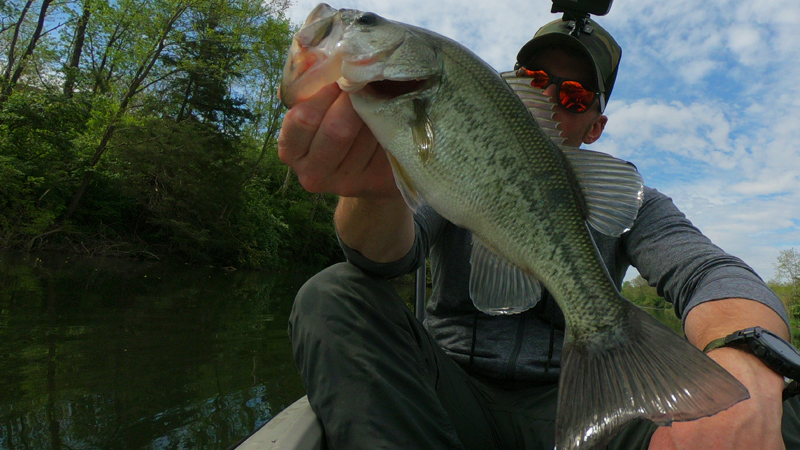
Later in the day this bass swooped out from a steep bank with a large overhanging tree providing shade and overhead cover. Light line & tackle were key because the water was clearer in areas with these steep banks where I found most of my fish.
But that’s ok.
She’s still in there… and we’ll be back.
My friends, these places are out there, and they are worth the effort when you find them.
So that’s what I’ve been up to. That’s what I’ll be up to again soon. And I hope by reading this, it has rekindled your interest in exploration. Pull up a search on local SF&W areas, and see if there are a few bodies of water off the beaten path.
Maybe I’ll see you out there… but hopefully… I won’t.
Tight Lines & Godspeed, Patriots.
Get Articles & Videos First
Catch More Fish Than Your Friends. Laugh At Their Tears.
Your support directly funds the creation of weekly articles and videos that promote the development of better anglers and better men. Our country (and our kids) need both. Please share this site, and consider a monthly, weekly, or one-time donation. You are helping us make a difference!
Fishing starts Monday. I’m hitting the water rain or shine, enough waiting – tomorrow we’re headed to Southern Illinois for Prison Ministry. I am excited for both of these things.
The other day we talked about Fishing Borrow Pits. What they are, where they come from, and how they can be repurposed:
Borrow Pits can be amazing, low-pressure honey holes if you find one that has been stocked. If it has limited shoreline access and it’s difficult to fish with a full-size bass boat, all the better! The result is a lot of unpressured water for us jon boat enthusiasts to explore… but the bass here are wary. Smart. You can’t clobber them over the head with the big rigs you’d use in a muck-covered city lake…
Today, we’re going to talk about my Top 8 Borrow Pit Baits. I went back and looked at the spreadsheet from last year, and tallied up all of the most productive ways that I fished these clear-water, steep bank, high visibility lakes. The name of the game is natural. Stow the buzzbait, huge rattles, giant jig with massive trailer that has unnatural pincers straight from the depths of hell, and the 10″ high-vis Senko – start natural.
Plan to work the entire water column, and explore. If the pit doesn’t have cover and structure that the fish can relate to, they may roam. This means that temperature and water depth will be the main variables you’ll want to focus on. Look for areas with slightly warmer and cooler water at different depths, and prepare yourself mentally – it’ll be tough, but worth it!
Start with a Quality Topwater
Start by working along the bank with a topwater to see if you can find any active biters. This allows you to cover water, and let’s be honest – topwater strikes are just downright fun! Downsize your offering and try out a walking bait like a Zara Spook Puppy or a Mann’s Baby 1-Minus in natural colors, worked at different speeds. If you reel slow, you can work the Mann’s like a wakebait or speed it up to go slightly subsurface. On windy days with chop, I lean towards the Spook for a bit more splash & visibility.
Another couple baits that will allow you to cover water and work slightly deeper are the Rapala Husky Jerk Minnow, and the Donkey Tails by Mule Fishing Supply Co. The latter is a small paddletail swimbait that catches everything, and the jerkbait will attract bass of all species and all sizes. Bomb the paddletail on light line and reel it straight & slow. If you feel weight, set the hook. No need to twitch, jerk, bounce – just keep it simple. If you want a slightly more active presentation, toss the jerk.
Nothing yet? Sun high in the sky? Time to Finesse…
Chances are at some point throughout the day, you’ll catch more with a finesse presentation. I love to work a Pop ‘n Drop whenever possible – but in clear water like this – having a popper chugging along isn’t always the attractor we hope it would be. Instead, suspend a 4″ Strike King Ocho underneath a float, and cast it up towards the steep banks. You might want to leave this bobber trailing behind you as you work an active presentation (if 2 rods per angler are allowed in your state). This allows you to put a plastic in front of their nose for an extended period of time, and on light line this can look very natural. The Ocho also has more salt than a Dinger and sink without requiring lead splitshot on the line – making it even less visible.
My best Borrow Pit “Bobber Bass” – not too shabby for a 3″ YUM Dinger!
Speaking of Dingers, If you want a sinking option to float down by the steep banks below any overhanging trees, play with the Neko Rig. Rig a 4″ or even a 3″ YUM Dinger wacky style with a small o-ring (this is critical as it gives you more exposed hook / increases hookups) and place a light nail weight in one end of the bait. This is a subtle sinking presentation that can add a bit of erratic behavior on the fall, triggering strikes. It can also “fall back into” trailing bass, depending on the position of the weight.
Two other presentations I’ve caught fish on that deserve your consideration include the Z-man EZ Tube rigged up on a jig, and the Berkley Powerbait Twitchtail Minnow, also on a jig. I use fluorocarbon with both. The tube spirals on the fall when you cast it up to a bank, so it can generate a reaction strike. The Twitchtail Minnow has a straight, vertical fall, and I like to hop this along the bottom, mimicking a small baitfish pecking through the sand & rocks.
Both will work on largemouth bass and smallmouth bass if they are present. The tube in particular seems to work well next to steep banks, but I have seen fish swim up and back off at the last second in open water where they can get a really good look – might just be my experience though… and in those same situations, the smaller stickbaits seem to coax more strikes. Test this on your lake.
Another note on tubes and vertical walls – notice the brush that overhangs the steep bank in the photos below? This provides overhead cover, and just like a creek with overhanging trees, it is possible for bass to get conditioned to caterpillars and other bugs falling in on windy days.
Finally, there are two other tools that you’ll want to make sure you have, even if you’re in a smaller boat. The first is a quality fishfinder like the Garmin Striker Vivid 9sv (a killer little unit that won’t break the bank but allows you to create your own contour maps as you fish – very important for little lakes without any Navionics charts), and a quality trolling motor. I’m seriously considering picking up a Minn Kota Powerdrive… which would be more expensive than everything in my little jon boat combined, but also allow me to work a bank hands-free.
This would be a gamechanger for me as I often fish alone, and fighting the wind ripping across a big flat pit is a full time job…
These tools help you with stealth, and they help you find sunken treasures, depth changes, holes and other contours that can hold fish in these crystal-clear borrow pits.
For me – these are must-haves!
Did I miss something you love to fish with? Let me know!
Your support directly funds the creation of weekly articles and videos that promote the development of better anglers and better men. Our country (and our kids) need both. Please share this site, and consider a monthly, weekly, or one-time donation. You are helping us make a difference!
I was sitting up last night tying rigs. We’ve had yet another cold snap here in Illinois, with nighttime temps dropping below 30 degrees. There is an upcoming prison ministry trip scheduled for Friday, so it looks like things have been postponed just a bit longer… no matter… this too shall pass.
I was thinking about the rigs that we had modified or created within the last 12 months after going through The Trophy Room, looking at examples of each one working…
Get Articles & Videos First
Catch More Fish Than Your Friends. Laugh At Their Tears.
First, we have the F4 Rig, which is super-versatile and allows you to quickly switch between a Carolina, Texas, or in-between rigs, with or without a clackin’ sound.
The F4 Rig: Muckin’ a City Lake
Then we have the Pop ‘n Drop, which allows you to combine a popper with a trailing stickbait that stays off the bottom or suspends subsurface over deep weeds.
The Pop ‘n Drop Over a Deep Creek Hole
Whenever I share these in a video, someone comments, “oh shoot – I need to try that!”
(Yes you do – and you should let me know how they work for you, and if you have any suggestions!)
Later this year, we’ll reveal another combo I’m working on, called The Snakebite Rig. The Snakebite Rig is meant for fishing largemouth bass in areas with a combination of muck and tall, slender weeds (think grass or even cabbage) from the bank or the boat. Every part of the rig has been designed to be as weedless and muckless as possible.
It works.
One extremely important element of that rig, is the combination of knots. Knots are important for a variety of reasons. Certain knots work well with specific line types (uni-knots can “burn” and fray fluorocarbon lines, reducing their strength). Different knots have different breaking strength (often fishermen will tie leaders using a knot with a lower breaking strength by the bait, so if they snag the rig will break there, and they can simply tie another bait on, not be forced to retie their entire leader).
Knots all have a tag end that can cause issues
I know… I used to ignore this as well… but when I was working on The Snakebite Rig it forced me to look at every single part of the setup, because I was sick and tired of pulling weeds and muck and crap off of my line every cast. It’s a waste of time. It forces you to lose focus. It’s annoying.
This leads us to the question: what is the best knot for attaching fluorocarbon leaders to braid?
The answer, is The Alberto Knot.
What!? Why!? Why not the popular FG Knot?
Great question! For starters, you need to be a rocket surgeon to tie an FG Knot. And three hands. This is not ideal for retying a leader on a windy day when you’re on the water. But, if it were the best option, it would still be worth the effort to master the technique. However, look at the direction of the fluorocarbon tag end when you tie an FG Knot.
Forward Facing Fluorocarbon Tag on an FG Knot
It’s facing forward, and it will pick up weeds & muck as it comes through the water that direction.
That can be a BIG problem.
Check out The Alberto Knot, and notice that the braid tag end is the one that is facing forward – but braid is supple, and if you leave a quarter or even a half inch tag on said braid, it will fold back nicely and lay flat, making the Alberto Knot much more weedless… or if you’re in the Midwest like me… much more muckless.
How to Tie the Standard Alberto Knot
That gray tag end you see above is braid, and it will fold back easily as it comes through the water. That means on the front side of our connection, we have some rounded fluorocarbon, and some rounded braid.
Silky smooth.
Combine this with a Weedless Uni-Knot (the tag end on a weedless uni points back, not forward) at the bait connection, and we’re in business! Oh… speaking of Uni-Knots…
What ABOUT Uni-to-Uni-Knot connections?
Great question. I use these often, because they’re easy to tie… but they do have three major problems:
The hard fluorocarbon tag still points forward
This connection is slightly bulkier than The Alberto Knot
It is very easy to burn your fluoro if you cinch your braid down a bit too tight before you pull the knots snug with one another
Double Uni-Knot Creates 2 Tag Ends and Braid can Burn Fluoro when the Knots are Cinched.
So to recap – these are the main reasons why I think The Alberto Knot is the best knot for braid to fluorocarbon leaders:
An Up-Close Alberto Knot
The Alberto Knot is easy to tie
The Alberto Knot won’t burn your fluorocarbon
The Alberto Knot has a low profile
The Alberto Knot is strong
The Albert Knot is very weedless, with no forward-facing hard tag end
Now… if you want to get super-fancy…
The Improved Alberto Knot
… you can improve The Alberto Knot by adding three extra wraps before you end the process and cinch down, like this:
Extra Wraps on an Alberto Knot – The Improved Alberto Knot
I strongly recommend you take this extra step if you are using heavy fluorocarbon leaders!
Give it a shot and let me know how it works for you. Ultimately when it comes to knots, confidence and reliability are key – if this is something new, tie several in the garage prior to hitting the water – test them, and repeat the process until you get ’em right.
Once you do, it’s simple and effective.
Tight Lines & Godspeed, Patriots.
Get Articles & Videos First
Catch More Fish Than Your Friends. Laugh At Their Tears.
Your support directly funds the creation of weekly articles and videos that promote the development of better anglers and better men. Our country (and our kids) need both. Please share this site, and consider a monthly, weekly, or one-time donation. You are helping us make a difference!
These days… everything is a code red… but I want to warn you about a problem with fishing line. Specifically, spooling with braid.
The Benefits of Braided Fishing Line
Braided fishing line is strong, slippery, limp & easy to work with. It doesn’t stretch or become water-logged, and it has a super-small diameter when you compare it to monofilament of fluorocarbon with the same strength rating. For example:
Berkley 30 pound Big Game mono has a diameter of .55 millimeters.
Berkley 30 pound X9 braided line has a diameter of .20 millimeters.
That’s significantly less than half.
This is rather impressive! So… what’s the problem?
What a nice way to make friends.
Disadvantages of Braided Fishing Line
Monofilamenthas some stretch, braid has none. This can be advantageous with certain techniques, like crankbaiting, where you want to give the fish a bit more time to engulf the lure, or help prevent ripping sticky treble hooks out of their mouth.
Fluorocarbon is invisible underwater, and it has better abrasion resistance than braid – meaning it is less likely to get frayed around rocks and timber.
Caught this fatty around shallow rip-rap using 10lb fluorocarbon and a jerk.
Ultra-thin diameter braid can also get “buried in on itself”, where the line near the top layer will slip through the lower layers of line on the spool as you put pressure on the other end of the rod with a hookset, or boat flippin’ bass.
There just isn’t a one-size-fits-all solution for fishing line… and we all have our preferences.
BUT… here is something to watch out for… it’s an issue you can easily avoid:
Inadvertent “Free Spooling”
Click the banner to jump to The Minimalist Fisherman on YouTube.
Jump to the 4:00 minute mark in the video above.
Laugh at my incompetence!
LAUGH AT IT!!
It’s funny now… it was not funny then… when you spool up braid (especially tiny diameter braid) without using monofilament backing, you run the risk of losing fish as the entire mass can spin freely, allowing more line to come off the spool even with your drag absolutely cranked down.
Inadvertent free spooling.
Note: a “free spool” is any spool that can move freely on the reel without any interreference from a gear or drive mechanism, etc. Line comes off (you guessed it), freely. Some fishermen will compare this to “neutral,” and when you skip backing your braid, you will enjoy this “feature” whether you intend to or not!
Is this “spinny braid” problem technically free spooling?
No.
Is the end result pretty darn similar?
Accidentally, yes.
This has been an issue with me for spinning rods, however, I have not experienced the same issue with baitcasters – but – that’s because I will usually tie my line through one of the holes in the spool on my baitcasters, which allows my braid to “lock” into place and not free spool.
If this is not an option on your reel, get some mono backing for your baitcasters as well – and hey, if you have any tips or tricks that you use for better fishing line management, comment & let me know!
Life is full of things we can't control. This is just the truth. Truth matters. That said, it's always a good idea to be mindful of the things that we can control. This will reduce headaches on the bank, in the boat... and bigger picture - throughout life in general.
Tight Lines & Godspeed, Patriots.
Get Articles & Videos First
Catch More Fish Than Your Friends. Laugh At Their Tears.
Your support directly funds the creation of weekly articles and videos that promote the development of better anglers and better men. Our country (and our kids) need both. Please share this site, and consider a monthly, weekly, or one-time donation. You are helping us make a difference!
Have you ever wondered how much fishing line you have left on your spool?
I’m not asking if you’ve wondered how much is sitting on the spool of your reel – I’m asking if you are looking for a way to tell how much fishing line you have left after spooling up?
Ever tossed out a spool with fishing line still on it instead of attempting to use every last yard, because you thought there wouldn’t be enough for more than one spool? It sucks, but it’s understandable. We don’t want to put ourselves in a situation where a big ‘ol fish could start ripping drag and spool us completely… but hey, good news:
This is how you get the MAXIMUM use out of a spool of fishing line.
Glad I was using braid this morning and didn’t get spooled… this was an awesome fight in the kayak!
Using the following method saves money and guesswork, but first, grab a new spool to work with:
How to Spool Multiple Fishing Reels with Less Line
I love to use braid. And fluorocarbon. And Braid with fluorocarbon leaders. Or braid with monofilament backing. These fishing lines are expensive, but you can save some money if you buy them in bulk. However, I don’t respool enough to justify 3,500 yards of braid or fluoro… so like most mere mortals, I stick with the 150 or 300 yard spools.
While most fishing reels show some sort of line capacity guide right on the side of the spool (or the reel itself) it’s typically shown in a diameter that I am NOT planning to use.
The Lew’s shown above will hold 120 yards of fishing line with the diameter of 6lb monofilament.
The Pflueger shown above will hold 200 yards of fishing line with the diameter of 2lb monofilament.
So the volume of line your spool can hold is dependent on the size (diameter), not the strength rating (pound test).
If you are doing a straight spool – let’s say we’re going to fill the Lew’s 100% with 10 pound test InvizX – then the conversion from 6lb test mono to 10lb test fluoro is rather straightforward. A common average diameter for 6lb test mono is 0.009″ (that’s inches), and an average for 10lb fluorocarbon is 0.010″ (again, inches – make sure you get the exact diameters of the lines you’re using, in the same unit of measurement).
By plugging in the diameter of both lines (0.009″ & 0.010″) and the starting capacity of the reel (120 yards) we can see that it is possible to put 97 yards of fluorocarbon on our spool.
This means that if our fishing line spool for the InvizX fluorocarbon contains 200 yards to start – we can completely spool up two of the reels in our example with 97 yards each, and even have a few yards to spare. This allows me to spool up without using some sort of line counter or wasting any expensive fishing line.
Here’s another example. Let’s say we want to put 40lb braid on our small Pflueger spinning reel that holds 200 yards of 2lb test mono (for some unknown reason) – that conversion looks like this:
Not a great idea… but even if we decided to do this, we would know that we only used 30 yards off of our 300 yard spool of braid. We have 270 yards remaining for a baitcaster.
This reel has a spool that will accomodate 110 yards of 12lb diameter line. (Again, these sizes are usually still listed in monofilament, which is why on packages of braided line you usually see a diameter for “mono equivalent“.)
I want to add some leftover mono to my new baitcaster as backing so that the braid has something to “bite into” (even though this isn’t required on spools with holes in them – just run the line through before you tie your knot to prevent slippage). This will prevent it from slipping on the spool (I know, I know, this is mainly an issue on spinning reels, not baitcasters – just work with me here! This is an example!), and I just so happen to have 20 yards of 6lb monofilament left over from my first example…
Step 1: Add the spool capacity (110 yards of 10 pound mono which is 0.013″)
Step 2: Add your backing material (20 yards of 6 pound mono which is 0.005″)
Step 3: Plug in your mainline (65lb Sufix 832 braid which is 0.016″ )
Step 4: Read the results… with this combination, my spool will hold 71 yards of 65lb braid, and the overall length of my line plus my backing is 91 yards. That is total length of the line on the spool, even though this spool is rated to hold 110 yards.
We’re using thick braid, and additional backing, but we still know exactly how much we can fit onto the reel, and how much we have left on the 300 yard spool of fishing line!
Bookmark this page.
The next time you’re respooling in the garage, griping about the price of braid & fluorocarbon, grab these calculators so you can maximize your fishing line usage!
Your support directly funds the creation of weekly articles and videos that promote the development of better anglers and better men. Our country (and our kids) need both. Please share this site, and consider a monthly, weekly, or one-time donation. You are helping us make a difference!
“Row row row your boat, straight into the wind. Merrily merrily merrily merrily batteries died… again…“
I am so sick of rowing.
This year I’ve been forced to fish differently. Bank fishing has been very unproductive. Probably several factors at play here, but whatever the reason, the challenge is good. I am grateful for the tough bite. It has forced me well outside my comfort zone… and as a result, it’s taught me many valuable lessons.
I shared one of these lessons recently, discussing a critically important concept for fishing Illinois smallmouth bass in creeks.
The Most Important Creek Fishing Tip “Last year I fished creeks all through October and into November, but I only landed dinks. Why? I’ll tell you… because on this rainy, cold October day… I figured it out…”
That article focused on tips for more fish. Sweet. Everyone likes that. Another post featured even more fishing tips. See the pattern? Fishing tips, fishing lures, fishing techniques – that’s the fun stuff!
How To Fish Ultra-Clear Borrow Pits & Rock Quarry Lakes “[The quarry lake] was beautiful. It was peaceful. It was… challenging… and after eating even more humble pie, I learned a few things that helped me connect with fish I don’t normally target… I’ll share those things with you now.”
Today though, we’re going to focus on a safety.
Why?
You Can’t Catch More Fish If You’re Dead.
Pause.
Run it back.
Reflect with me for a second.
You can’t catch fish when you’re pushing up daisies. Mother Nature is not someone you want to test. Whether you test her by wading a frosty creek in frigid temperatures wearing shorts in the rain, or by heading out on a very windy day on a lake that only allows electric motors, relying on compromised boat batteries.
I’ve done both in the last week.
The wading-in-shorts thing we covered, but the other one… fishing a lake on a windy day with underpowered batteries… that ain’t safe. Period. The reason the title of this article says “Don’t Be Stupid“, is to serve as a reminder to myself.
I have been stupid.
Here’s what happened…
The First Time My Battery Died
I was on a beautiful quarry lake. Nature was alive & breathing. Muskrats, squirrels, deer, many kinds of birds and all the awesome sounds that come along with them. They worked together. Played a song for me. Water visibility was super-high, which made fishing tricky – but it also made for some breathtaking views. My little jon boat floated over deep rocky humps covered in huge boulders and sparse grass, with steep sloping edges that disappeared quickly into the dark abyss.
Gorgeous.
Groups of largemouth bass were sitting in the sun on rocky flats. By the time I saw them there was no chance of catching them. Bass in water this clear are wary of shapes, sounds & shadows approaching. They’ve seen birds pluck their friends from the water. Still, I was able to see them clearly in the crystal-clear lake, and enjoyed watching them lazily swish their tails, moving off into the deep, dark, water.
Safe. Away from this intruder.
Scooting around in my jon boat, launching a plastic far ahead of me did bring in a few quality fish, but after a while I noticed something…
My depth finder screen had turned off. Odd. I held the button to turn it back on, and the screen lit up… until I engaged my trolling motor.
*BLIP*
Dead… weird… then I looked down and saw that my prop was spinning at about 15%… barely moving the boat. Something must be wrong with the battery… I guess?
This was a bad deal. Short on time, the misses would be annoyed if I wasn’t back to pick up the boys from school. My family is very supportive of my hobbies, but if fishing starts to cause inconveniences in our day-to-day routine, it’s going to become an annoyance.
We can’t have that.
I grabbed my emergency paddle, and started slapping water – hard. Like I was mad at it. You know that phrase “swearing like a sailor”?
Yeah.
Consider me Captain Ahab.
The jon boat is just wide enough that I couldn’t stay in one spot when paddling, so I had to move sideways about a foot in between rows. The combination of side-to-side movement and water-smacking caused me to start sweating like a you-know-what in church.
The ridiculously short paddle and my scoot-scoot-row technique allowed me to move at the speed of molasses back towards the ramp. I was never going to make it in time…
“Hey buddy, you need a tow or you just getting a workout in!?”
I looked up as a bearded man – with waders and a working trolling motor – silently approached. Like a burly angel sent from heaven, he was perched majestically atop the deck of his Lund (a far superior vessel) and clearly took pity on me.
Not one for charity, his generous offer was impulsively declined.
I hollered back:
“No thanks man! I think I got it!!”
He paused and looked at me sideways, unconvinced. Sweat continued to pour off my face, splattering my clothing and the commercial grade carpet lining the bottom of the jon boat.
“… you sure?”
I thought about letting my wife down. Being super late would be a massive inconvenience for her, and very annoying, no matter the reason. Without a doubt, future fishing trips hung in the balance.
Y’all know the dance…
“Actually, yeah man, that would be really awesome.”
“No worries. Name’s Greg. Take this rope and let’s getcha back to the ramp.”
Greg from Geneseo gave me a tow. He’s a good guy, that Greg. Be Like Greg. Thanks Greg!
A bad situation. A bearded savior. A lesson learned.
Oh, and yes – I made it back in time to get the kids – but this wasn’t my last problem with a battery…
The Second Time My Battery Died
Let’s clarify – batteries.
Plural.
On this day, I learned just how dangerous boating with underpowered batteries could be.
I went to the same lake, and the wind was blowing hard. Instead of the small emergency paddle, a longer kayak paddle was stowed under the front deck. Surely I wouldn’t need it with two batteries, but you know… just in case. No doubt about it, between the longer paddle and the two batteries, we’re definitely properly equipped! What could possibly go wrong?
Never ask that.
I stayed close to the shore and worked a Z-Man EZ Tube up under the overhanging roots. The tube jig stuffed inside was light (1/16 ounce) and the hookpoint was exposed. This, paired with a 3 foot fluorocarbon leader allowed the bait to sink sloooooooowly, with a slight spiral.
The result was a series of healthy largemouth & smallmouth bass:
Nice quarry bass snatched up my Z-Man EZ Tube on the fall. 10 feet offshore it’s 23 feet deep below the boat. Another chonk on the tube.Smallmouth like the tube, too – this lake is awesome!
Everything was clicking. My Garmin STRIKER was charting the bottom. We were making sense of these spooky fish. The sun was shining and the wind helped keep the bass fired up. Cloud nine, baby!
*BLIP*
The Garmin died.
No worries, we’ll just swap in the backup… but… man the battery didn’t last very long. Maybe an hour? Must be because we’ve been traveling into the wind. All good, the second one will last longer.
Fished another hour, pushing straight into 25+ MPH winds. Had to stay right next to shore, because when the jon boat drifted into the middle of the lake the wind was so strong I couldn’t even move forward. More and more bass came in over the side of the boat as we charted additional contours.
Finally, we arrived at the far end of the lake.
*BLIP*
…
“Oh… what? No. No no no no no nononononooooo. Really? Both of ’em?!“
Really.
Dead as a doornail.
Out came the kayak paddle, along with the sailor vernacular.
I paddled. And paddled. And paddled. After an hour I was halfway back to the launch, and I stopped to think for a second. The wind was at my BACK.
… what if it wasn’t???
I’d be stranded.
Literally.
Most of the shoreline here is almost vertical – far too steep to walk the boat back. I remembered that earlier in the day the wind was so strong that even with the trolling motor running full bore, I couldn’t move ahead. Couldn’t push through it.
If I couldn’t do that with a motor… what hope did I have with a paddle?
None.
This realization caused me to get sick to my stomach. Would I die? Well not from the wind, but I’d be stuck, and that’s dangerous. So much could go wrong. What if my batteries were dead and I went over the side of the boat and got cut up bad on some brush and timber? What if I broke a bone or cracked my face open on one of these huge boulders? It’s not impossible… but what then??
These thoughts rushed through my mind, each scenario getting more and more outlandish – yet the fact remained – if the wind had shifted direction, I’d be stuck. It’s just a situation that needs to be avoided.
Paddling resumed.
When I finally rowed around the bend and into the last 100-yard stretch by the launch, I noticed two gentlemen targeting panfish. I had passed them much earlier in the day, and they hollered out:
“Good to see you made it back, we were just about to come looking for you! This wind is nuts, we went out there ourselves but decided to come back… glad you didn’t get stuck, or tipped!”
These men were fishing in a bigger boat. Had a bigger trolling motor. Bigger batteries no doubt. Yet they decided the wind was too much to tangle with.
I was out here in my jon boat.
Lesson learned… well… kind of…
The Third Time My Batteries Died
It happened again.
Yesterday.
Just a glutton for punishment.
Now don’t get me wrong, these days I check the direction of the wind before I head to the lake – then double check before I launch. I make sure to have my two (compromised) batteries, and I have a third Power Wheels battery jerry-rigged to run my sonar (thanks, kids). The long kayak paddle is now a permanent fixture on the jon boat, and I try to start far away and fish my way back to the launch… but sometimes… sometimes the siren song of those pit bass, man… it’s just too much to handle, and I have to go explore and fish for ’em!
Things started off well.
This new rock quarry lake, not far from the other pit, was beautiful. I popped in and immediately started mapping the bottom. Had a few small bass hit a Yum Dinger in smoke / pearl laminate with a Neko weight stuffed in one side. This was tossed out on an o-ring with a light wire wacky hook. The o-ring is extremely important – not because it helps me save baits (which it does) – but because it allows me to have the least amount of plastic on the inside of my hook. This means better hookups, and more fish in the boat. It is a ton of fun fishing with these tiny hooks for strong largemouth & smallmouth bass! 8 pound fluorocarbon line is as light as I’ll go. Full spool. Everything is slathered in Dr. Juice because Matt Straw says it works – and that’s good enough for me.
In crystal-clear water like this, you learn pretty darn quick that if you don’t go light – you don’t get bit.
I continued to fight my way ahead, into the wind. After 30 minutes I switched to a green pumpkin with purple flake, and started to get more frequent bites. A few bigger fish as well.
“Well… we got two options. Hook up battery #2 and risk getting stuck way out here and paddling back… or… paddle now and fish, then hook up later and head back using the trolling motor…”
I opted to paddle into the wind, back into a bay I wanted to explore. Planned to chart the bottom contours along the way, even if we were not moving very fast.
Then the wind punched me right in the face.
Cue sailor-speak…
“^%$@!(*&#!!&*&^%!!!!!”
I was paddling as fast as I could just to stay in place. The wind would die down, slight forward progress would be made… suddenly more wind would whip up and stop me – then die – I’d move ahead 50 feet – on and on and on this frustrating cycle repeated itself until I made it to the back of the bay.
When I arrived, I had wasted 75 minutes of precious fishing time, and I was drenched.
Bad choice.
I hooked up and headed home, feeling defeated.
That night I wrote in my fishing journal:
“NEVER AGAIN! JUST STOP! This is not safe, and on top of that it’s a waste of time. These batteries are shot, and you have to figure something else out before you waste more time, get really hurt, or worse…”
Problem is… I don’t want to stop – I want to fish! It’s cold in Illinois, but they’re still biting in these quarry lakes!
That said, unless I fix my power situation, I’m done for good. This year, next year, and beyond.
Time for a Battery Upgrade
After talking to quite a few fisherman, I think I’ve found a solution. There are several new battery types that seem more powerful than my stock Farm & Fleet marine battery. Batteries that could keep me fishing for 6 or 7 hours safely, even in the wind. One that I’ve really been looking at is the Mighty Max Deep Cycle Lithium Iron Phosphate Battery… but… I can’t afford it.
This is a 200ah (amp hour) model. It is 10 pounds lighter than my 80ah (compromised) battery. It is also $950 less than a Dakota Lithium Battery of the same size.
Now word on the street is that LiFePO4 batteries can outlast lithium ion by 4x to 5x, so that is a consideration. Lithium ion batteries can also overheat and light on fire. But note that the Mighty Max is lithium iron. Lithium iron batteries are superior to lithium ion in terms of chemical & mechanical structure, plus they don’t overheat to unsafe levels.
I don’t know if LiFePO4 is the same as lithium iron (If you know, or have a brand preference, please comment below).
However, my compromised battery delivers about half that (if I'm lucky), and since my battery is a wet cell, the lower the charge, the lower the voltage it puts out. This is why the prop spins slower. Now check out the upgrade:
200ah / 30 amps = 6.7 hours
I don't run my trolling motor constantly, so even if I were to play it safe, an upgrade like this could allow me to fish for 5 straight hours safely, without the motor losing voltage and thrust. Realistically, if I ran the motor at a mid-speed average, I'd only draw 15 amps...
200ah / 15 amps = 13.3 hours...
... but sadly, right now it's not in the cards... and I need your help.
This site has always been free. The videos are free. I plan to keep it that way, because I love fishing, and I love meeting people through the site and channel. Love it. But if you've ever learned anything valuable, please consider chipping in to help me get a few upgrades, so I can keep it up.
With your help, I can get back out there, fish longer... and fish safely.
Your support directly funds the creation of weekly articles and videos that promote the development of better anglers and better men. Our country (and our kids) need both. Please share this site, and consider a monthly, weekly, or one-time donation. You are helping us make a difference!














What do you think?